Adult learning in the UK: a complete study guide
Whether you are retraining, gaining a professional qualification or learning for its own sake, here is how adult study works in the UK and how to make limited time count.
What adult learning covers
Adult learning in the UK ranges from short online courses to degree-level professional qualifications. Adults study to change career, to progress at work, to meet professional requirements, to gain the English and maths they missed at school, or simply for the pleasure of learning something new.
Some of the most common routes are professional qualifications from bodies such as AAT (accounting), CIPD (HR and people practice), CMI and ILM (management and leadership) and CIM (marketing); Level 2 and Level 3 qualifications from awarding organisations such as City & Guilds, NCFE and Pearson; the Access to Higher Education Diploma for adults preparing for university; and continuing professional development (CPD) in regulated professions.
Courses are delivered in many ways: evening classes at a local college, part-time university study, workplace programmes, and fully online, self-paced learning.
Popular professional qualifications for adults
Most professional bodies offer qualifications at several levels, so you can start where you are and progress. Levels follow the Regulated Qualifications Framework (RQF) in England, where Level 3 is equivalent to A level and Level 7 to a master’s degree.
| Field | Body | Typical levels | Who it suits |
|---|---|---|---|
| Accounting and bookkeeping | AAT | Levels 2, 3 and 4 | New and developing finance staff |
| HR and people practice | CIPD | Levels 3, 5 and 7 | HR and L&D professionals |
| Management and leadership | CMI, ILM | Levels 3 to 7 | Team leaders to senior managers |
| Marketing | CIM | Levels 4 to 7 | Marketing practitioners |
| Teaching and training | City & Guilds, Pearson and others | Levels 3 to 5 | Trainers and further education teachers |
| Health and social care | NCFE CACHE, City & Guilds | Levels 2 to 5 | Care workers and managers |
Paying for adult courses
Funding depends on where you live, your age, your income and the course. In England, many adults can study English and maths up to Level 2 and some essential digital skills courses free, and eligible adults can access some Level 3 qualifications free through government-funded schemes. Rules and course lists change, so check with your local college or the National Careers Service.
For Level 3 to Level 6 courses, adults aged 19 or over may be able to take out an Advanced Learner Loan, repaid only once you earn above a threshold. Employers often fund professional qualifications and apprenticeships, and some professional bodies offer bursaries.
Adult and online learning subject areas
These are the adult and online learning areas on our UK curriculum map. Each was researched from the published syllabuses of the closest regulated or professional qualifications adults take, including AAT, CIPD, CMI, ILM, CIM, City & Guilds and NCFE, with QAA and Skills England frameworks where they apply.
Sciences 3 subjects · City & Guilds, AQA, QAA
Maths and statistics 1 subject · Department for Education, QAA
English and languages 2 subjects · QAA
Humanities and social sciences 6 subjects · AQA, QAA
Business, law and economics 5 subjects · CMI, ILM, AQA, AAT, QAA, CIM
Computing, engineering and technology 5 subjects · Skills England, City & Guilds, Engineering Council
Medicine, health and care 5 subjects · Skills England, Skills for Care, QAA, NMC, CIMSPA
Arts, media and performance 4 subjects · Pearson Edexcel
More subjects 4 subjects · NCFE CACHE, Skills England, CIPD, City & Guilds, ILM
Why learning as an adult is different
Adults bring something school pupils rarely have: experience. New ideas stick far better when you can connect them to situations you have already met, so make that link deliberately. For every concept you study, note an example from your own work or life.
The science of memory is the same at any age. Retrieval practice, testing yourself instead of rereading, and spacing, coming back to material at increasing intervals, are the two most powerful techniques we know of. They are also well suited to busy lives, because they work in short sessions.
What changes is time. Few adults can study for hours at a stretch, so the challenge is consistency: a little, often, protected from the rest of life.
How to study around work and family
Fix small, regular slots
Fifteen to thirty minutes at the same time each day, on the commute, at lunch or after the children are in bed, is easier to keep than occasional long sessions.
Start every session with recall
Before reading anything new, test yourself on what you covered last time. It takes minutes and strengthens memory more than rereading.
Use the syllabus as your map
Your awarding body’s unit list or syllabus shows exactly what is assessed. Work through it in order and tick off each unit.
Connect it to your job
Apply new models and frameworks to real situations at work. It deepens understanding and gives you material for assignments.
Plan around deadlines
Put every assignment and exam date in one calendar and work backwards, allowing for the busy weeks you know are coming.
Tell people what you are doing
Family, colleagues and managers are more supportive when they know your study times and goals.
Track progress visibly
Seeing units completed and streaks building is motivating, especially when progress feels slow.
Be kind to yourself
Missing a session is normal. Pick up again the next day rather than trying to catch up all at once.
Access to HE and returning to study
The Access to Higher Education Diploma is a one-year course designed for adults who want to go to university but do not have the usual qualifications. It is made up of 60 credits, 45 of them graded, and is widely accepted by UK universities, especially for subjects such as nursing, social work, teaching and the sciences.
If it has been a while since you studied, start with a short course or a Functional Skills qualification to rebuild confidence. Colleges and the National Careers Service can help you choose the right starting point.
Continuing professional development
Many professions require ongoing learning to stay registered, including nursing, teaching, accounting, law and the health and care professions. Each professional body sets its own CPD rules: how many hours, what counts, and how it should be recorded.
Effective CPD is more than attending courses. Reflecting on what you learned and how it changes your practice is usually required, and it is also what makes the learning stick.
How to choose the right course as an adult
Be clear about your goal. If you want a specific job or promotion, look at what employers in that field ask for, and whether a professional body sets the standard. If you want a career change, a short taster course can confirm your interest before you commit to a longer qualification.
Check the level and the time commitment. A Level 3 qualification might take a year of part-time study, while a Level 5 or 7 professional qualification can take longer. Ask how teaching is delivered, how assignments and exams work, and what support is available if you fall behind.
Look for recognised awarding bodies and regulated qualifications. In England, the Ofqual register lists regulated qualifications, and professional bodies such as AAT, CIPD and CMI list their approved centres.
Making online and distance learning work
Create a study space
A consistent place to study, even a corner of a table, helps you switch into learning mode quickly.
Set a timetable
Self-paced courses are easy to postpone. Fixed weekly slots keep you moving forward.
Engage, do not just watch
Pause videos to answer questions, make notes in your own words and test yourself afterwards.
Join the community
Course forums and live sessions make online learning less isolating and help when you are stuck.
Break big units down
Split each unit into small tasks you can finish in one session, and tick them off.
Review regularly
Without classroom repetition, spaced self-testing is even more important for remembering what you learned weeks ago.
Exams and assignments in professional qualifications
Professional qualifications are assessed in different ways. AAT qualifications are mainly assessed through computer-based assessments, so regular timed practice with sample assessments is key. CIPD and CMI qualifications are mostly assessed through written assignments applied to your own organisation, so planning, workplace evidence and clear structure matter most.
For exam-based units, use flashcards for definitions, rules and formulas, spaced over weeks, and finish with timed practice. For assignment-based units, read the assessment criteria carefully, plan your answer against them, and use real examples from work.
Improving your English and maths as an adult
Many adults return to English and maths, to help children with homework, to progress at work or to meet course entry requirements. Functional Skills qualifications focus on practical English and maths and are available from Entry Level to Level 2; GCSEs are also available at many colleges for adults.
Little and often works best: a few minutes of number practice or reading each day builds confidence faster than occasional long sessions. Focus on understanding methods, not just memorising steps, and use real situations such as budgets, recipes and work documents to practise.
Learning a language as an adult
Adults can learn languages very successfully, especially with regular exposure and practice. The foundation is vocabulary: learn the most frequent words first and review them with spaced repetition, ten to fifteen minutes a day.
Combine vocabulary with listening, speaking and reading from the start. Podcasts, films with subtitles, conversation classes and language exchanges all help, and short daily practice beats an occasional long lesson.
Retraining for a new career
Retraining is common in the UK, whether to move into a growing sector, return to work after a break or follow a long-held interest. Start by researching the role: what qualifications and experience employers ask for, typical salaries and how people usually enter the field. The National Careers Service and professional bodies are good starting points.
Many career changers combine study with practical experience, through volunteering, a part-time role, a work placement or an apprenticeship, which can be open to adults of any age. Your existing skills, such as communication, organisation and problem-solving, often transfer more than you expect, so highlight them alongside your new qualification.
A realistic study week for a working adult
This example fits a part-time professional qualification around a full-time job. Adjust the slots to your own routine.
| Day | When | What | Time |
|---|---|---|---|
| Monday | Commute | Flashcard review | 15 min |
| Tuesday | Evening | Read and summarise one topic | 45 min |
| Wednesday | Lunch break | Practice questions | 20 min |
| Thursday | Evening | Assignment work | 45 min |
| Friday | Commute | Flashcard review | 15 min |
| Saturday | Morning | Longer session: assignment or mock assessment | 90 min |
| Sunday | — | Rest, or plan the week ahead | 10 min |
That is around four hours a week, enough for many part-time courses, without taking over evenings and weekends.
Rebuilding confidence as a returning learner
Many adults worry that they have forgotten how to study, or that they were never good at it at school. In practice, adult learners often do very well: they are motivated, organised and bring experience that younger students lack.
Start with small wins. Complete a short unit, pass a practice quiz, or finish your first assignment, and notice the progress. Ask questions early, use the support your provider offers, and remember that struggling with something new is a normal part of learning, not a sign that you cannot do it.
The benefits of learning as an adult
Adult learning brings benefits well beyond a certificate. People who keep learning report greater confidence and wellbeing, broaden their career options and are better able to adapt as jobs and technology change. For many, a qualification gained as an adult opens doors that seemed closed after school.
Learning also changes how you think about challenges at work and at home. Studying a management model, an accounting principle or a new language gives you tools you can use immediately, and the habit of learning itself becomes a skill employers value.
The hardest part is often the decision to start. Choose something that matters to you, begin with a manageable commitment, and build from there. Even a short course can be the first step towards a much bigger change.
How to remember more of what you study
Busy adults rarely have time to relearn material, so it pays to study in ways that make knowledge last. After each study session, close your notes and write down, or say aloud, the three most important things you learned. That small act of retrieval does more for memory than another read-through.
Turn key definitions, frameworks and figures into flashcards and review them on a spaced schedule: the next day, a few days later, then weekly. Mix in practice questions in the style of your assessment, and connect each new idea to a real example from your own experience. Memory is stronger when it is meaningful.
Make short study sessions count
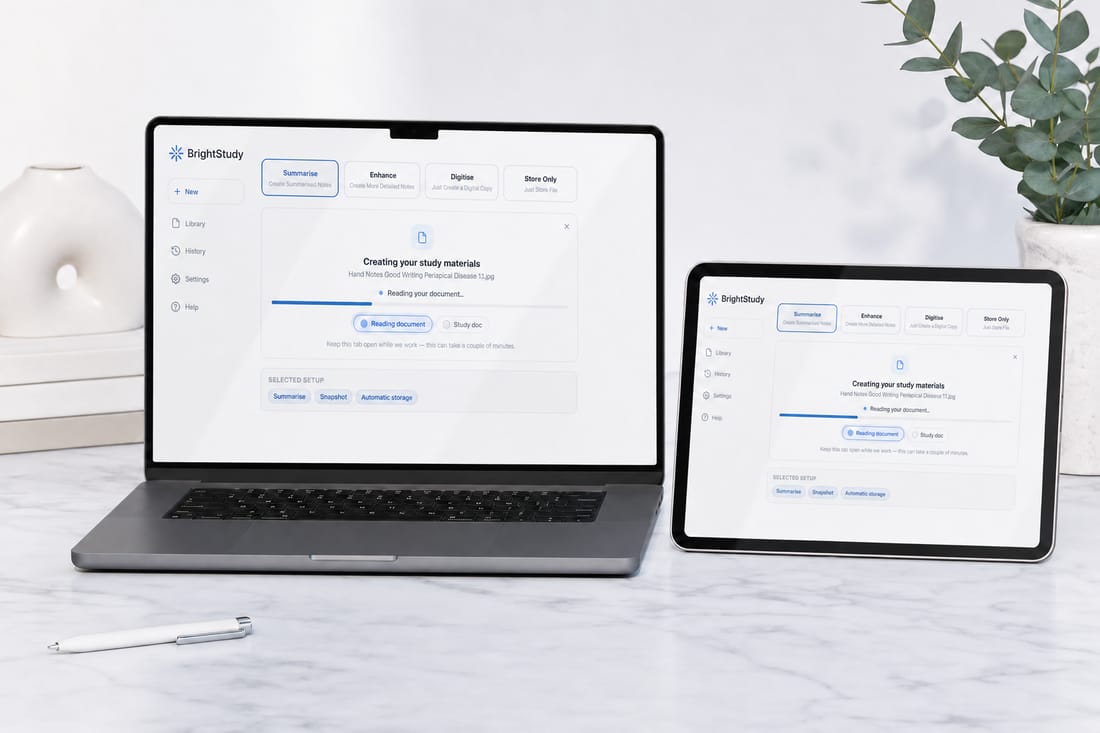
Upload your course workbooks, PDFs, slides, Word documents, photos of handwritten notes, recordings or YouTube lessons. BrightStudy turns each into a structured Study Doc, and can generate flashcards and multiple-choice questions from the same material.
On paid plans, an FSRS-based scheduler brings each card back just before you would forget it, so a ten-minute daily Due queue keeps everything fresh, which is ideal when study has to fit around work and family.
How BrightStudy fits adult learning
Free to start
The free plan includes unlimited flashcards, MCQs and Study Docs you create yourself, and lets you try the AI tools within an allowance.
Oracle, the AI tutor
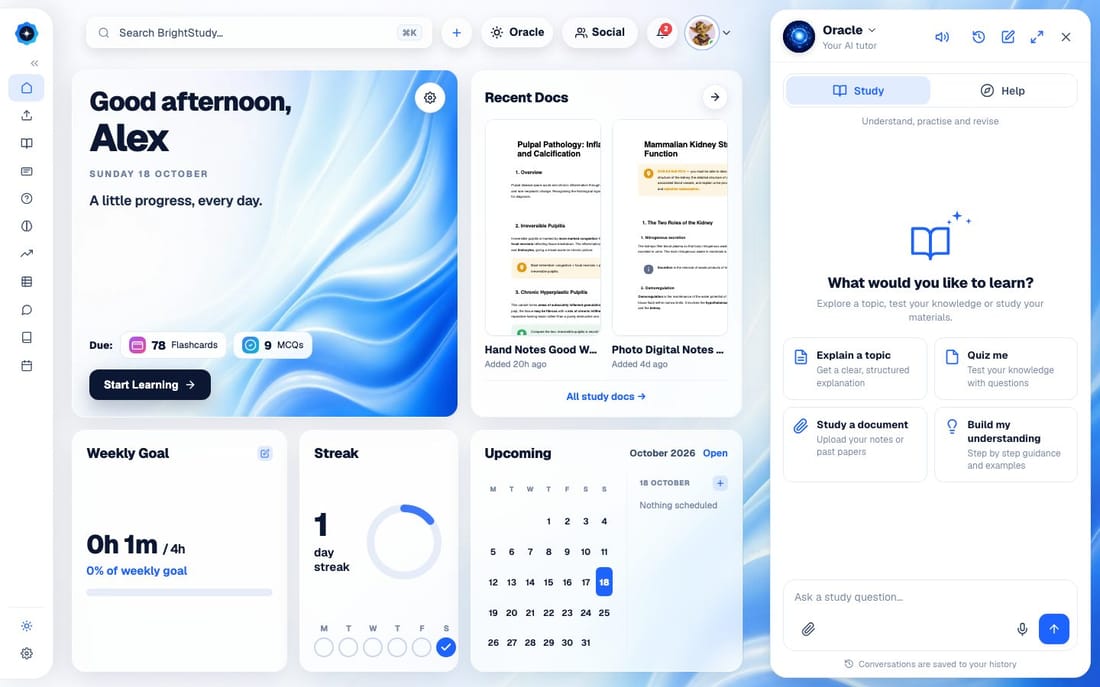
On paid plans, ask Oracle to explain a model or a regulation in plain language, or to quiz you on your notes.
Progress and streaks
On paid plans, see topic strength, accuracy trends and streaks, and set a weekly goal that suits your life.
Calendar
Assignment deadlines, exam dates and study sessions in one place.
Vault
Course materials organised in folders, searchable, with deleted items recoverable for 30 days.
Any device
Use BrightStudy in the browser on your phone, tablet or computer. Mobile apps are coming soon.
A study space you look forward to
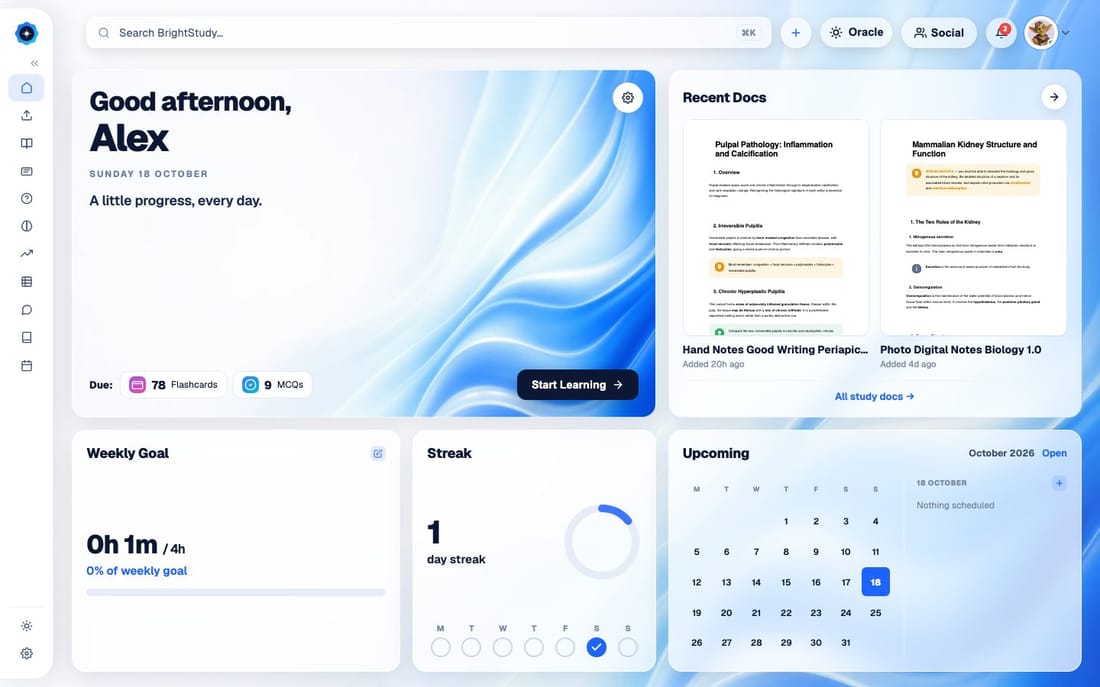
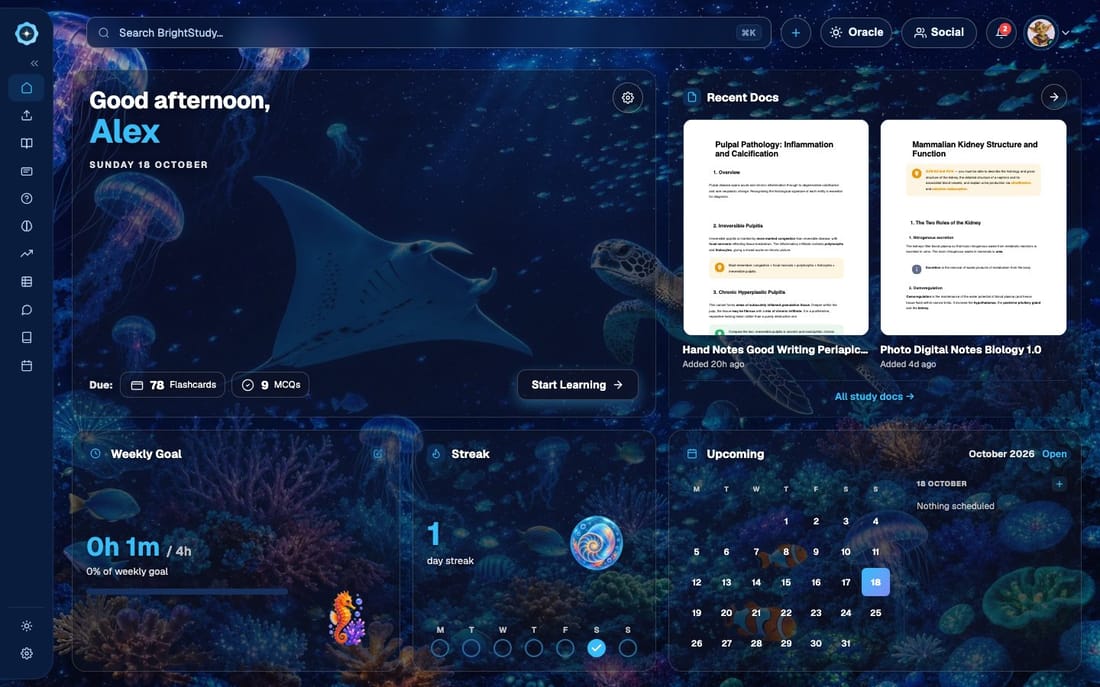
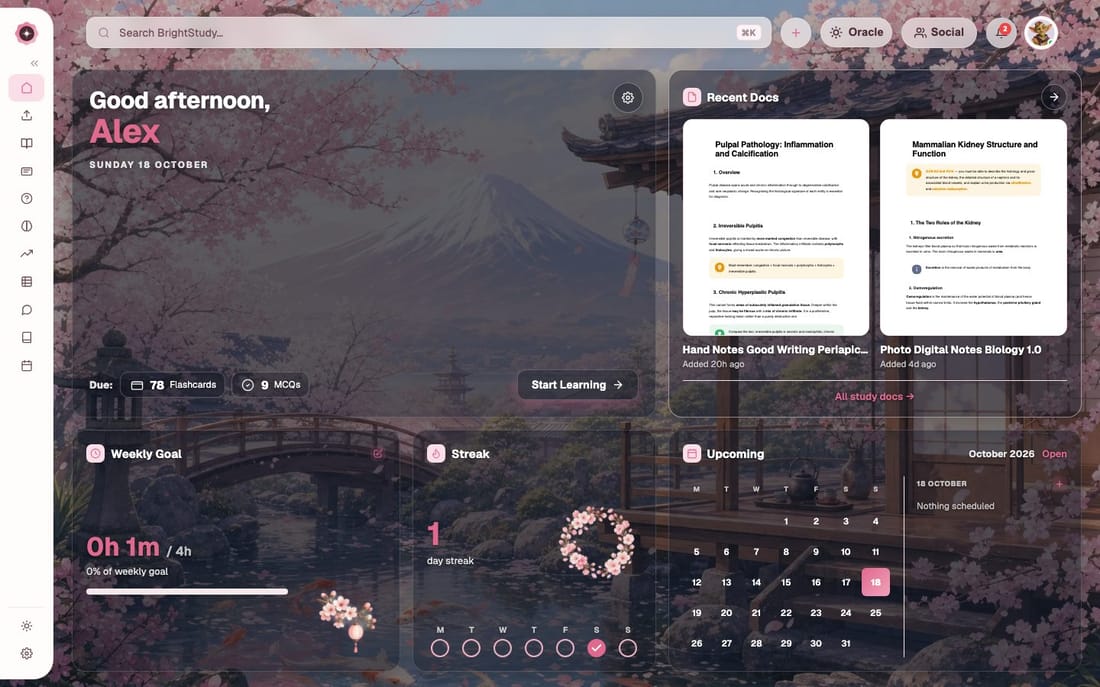
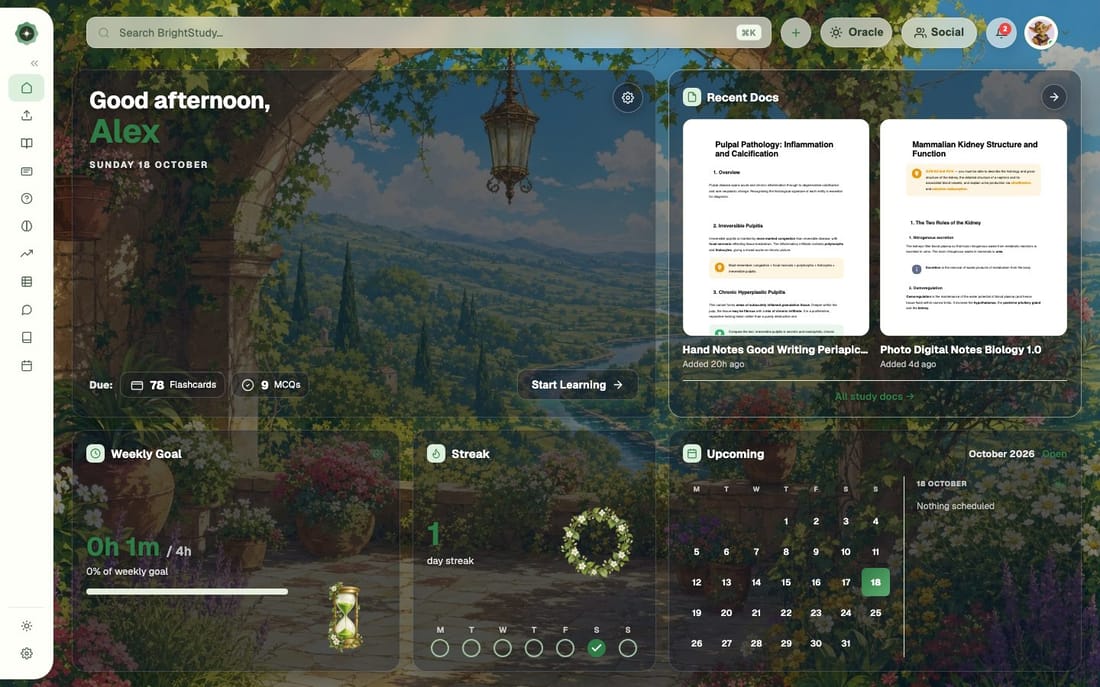
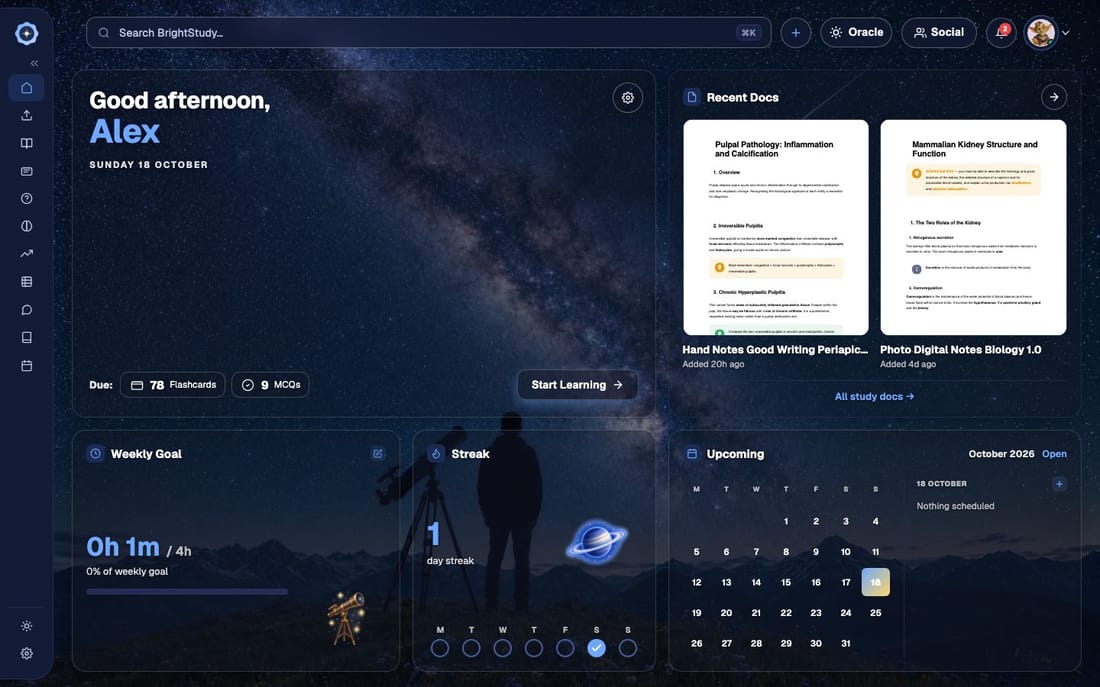
Choose from twelve themes, light and dark, and make BrightStudy feel like your own.
Common mistakes adult learners make
Waiting for free time
It rarely appears. Schedule short sessions instead.
Rereading the workbook
Self-testing teaches more in less time. Turn key points into questions.
Studying in isolation
Course forums, study groups and colleagues keep you motivated and help with tricky topics.
Underestimating assignments
Start early and plan drafts; professional assignments often need workplace evidence.
Giving up after a bad week
Consistency over months matters more than any single week.
Not asking for support
Tutors, employers and colleges offer more help than many learners use.
Adult learning: frequently asked questions
Is it too late to go back to studying?
No. Adults of every age study successfully in the UK, and life and work experience are real advantages. Starting with a short course can help rebuild confidence.
What is the difference between AAT, CIPD and CMI?
They are professional bodies in different fields: AAT for accounting and bookkeeping, CIPD for HR and people development, and CMI for management and leadership. Each offers qualifications at several levels.
What level is a Level 3 qualification?
In England, Level 3 is equivalent to A level. Level 4 and 5 are equivalent to the first and second years of a degree, and Level 7 to a master’s degree.
Can I get funding for an adult course?
Often, yes. In England many adults can study English, maths and some digital and Level 3 courses free, and Advanced Learner Loans are available for many Level 3 to 6 courses. Check with your local college or the National Careers Service.
What is an Access to HE Diploma?
A one-year, 60-credit course for adults without traditional qualifications who want to go to university. It is widely accepted for subjects such as nursing, social work and teaching.
How much time do I need to study each week?
It depends on the course, but many part-time qualifications suggest several hours a week. Short daily sessions plus one longer weekly session is a sustainable pattern.
How can I remember what I study when I have so little time?
Use retrieval and spacing: test yourself instead of rereading, and review material at increasing intervals. Even 10 to 15 minutes a day is effective.
What is CPD?
Continuing professional development: the ongoing learning many professions require you to record to stay registered or chartered. Each professional body sets its own rules on how much is needed and how it is recorded.
Can I study online for a recognised qualification?
Yes. Many regulated and professional qualifications, including AAT, CIPD and CMI, can be studied online through approved centres. Check the provider is approved by the awarding or professional body.
How long does a CIPD Level 5 take?
Many learners take around 12 to 18 months part-time, depending on the provider and how many units they study at once.
Is an Advanced Learner Loan worth it?
It can make a Level 3 to 6 course affordable, since you only repay once you earn above a threshold. Compare the cost of the course with the career benefits, and check whether free funding or employer support is available first.
How do I stay motivated studying alone?
Set small daily goals, track your progress, join a course forum or study group, and connect what you learn to your work or interests. Consistency matters more than motivation on any one day.
Can I learn a new skill in my spare time?
Yes. Short online courses and self-paced learning are designed for exactly that. Ten to fifteen minutes a day of focused practice and review adds up quickly.
Can BrightStudy help me study for a professional qualification?
Yes. Upload your course materials to create Study Docs, flashcards and questions, or write unlimited cards and questions yourself on the free plan.
Is BrightStudy free?
You can join for free. Paid plans add spaced repetition, progress analytics, AI creation and the Oracle tutor; see pricing.
What qualifications can I do as an adult?
Almost any: GCSEs and Functional Skills in English and maths, Level 2 and 3 vocational qualifications, apprenticeships, the Access to HE Diploma, professional qualifications such as AAT, CIPD and CMI, and university degrees, full-time or part-time.
Are online courses recognised by employers?
Regulated qualifications and those from recognised professional bodies are recognised whether you study online or in person. Check that the course leads to a regulated or professionally recognised qualification.
Can I go to university as a mature student?
Yes. Universities welcome mature students and often consider work and life experience alongside qualifications. An Access to HE Diploma is a common route for adults without A levels.
How do I balance study and a full-time job?
Set realistic weekly goals, use short regular sessions, protect one longer weekly block for assignments, and talk to your employer, who may offer study leave or support for work-related qualifications.
What is the Ofqual register?
A public list of qualifications regulated by Ofqual in England. It shows a qualification’s level, size and awarding organisation, so you can check what you are signing up for.
Can I learn at my own pace?
Many online and distance courses are self-paced within an overall time limit. Even with a flexible course, a regular weekly routine helps you finish.
How can BrightStudy help me remember what I learn?
Turn your course materials into flashcards and questions, then, on paid plans, let the spaced repetition scheduler bring each one back just before you would forget it, so a short daily review keeps everything fresh.
Other stages of UK study
Learning that fits around your life
Upload your first workbook and turn it into a ten-minute daily review.