Master’s and postgraduate study: the complete guide
How UK postgraduate qualifications are structured and graded, what a master’s dissertation involves, and how to keep up with the pace of a one-year course, including while working.
How postgraduate study works in the UK
Postgraduate study is anything after a bachelor’s degree. The most common route is a taught master’s degree, such as an MSc, MA, LLM or MBA, which usually takes one year full-time or two to three years part-time. It sits at Level 7 of the Framework for Higher Education Qualifications and is normally worth 180 credits.
A taught master’s typically combines two terms of advanced modules with a dissertation or major project, often worth 60 credits, researched and written over the summer. A research master’s (MRes or MPhil) puts more weight on independent research, and a doctorate (PhD or professional doctorate, Level 8) usually takes three to four years full-time.
Shorter qualifications are also available: a Postgraduate Certificate (PGCert) is 60 credits and a Postgraduate Diploma (PGDip) is 120. Many are built into master’s programmes, so you can exit with one if you stop early.

Postgraduate qualifications compared
Credit values follow the framework used in England, Wales and Northern Ireland; Scottish credit values differ.
| Qualification | Credits | Typical length (full-time) | What it involves |
|---|---|---|---|
| PGCert | 60 | A few months | A focused set of modules |
| PGDip | 120 | Two terms | Taught modules, no dissertation |
| Taught master’s (MSc, MA, LLM, MBA) | 180 | 12 months | Taught modules plus a dissertation or project |
| Research master’s (MRes, MPhil) | 180+ | 1–2 years | Mostly independent research |
| PGCE (teacher training) | Varies | 1 year | Teaching placements and study leading to qualified teacher status |
| Doctorate (PhD, EdD, DClinPsy) | — | 3–4 years | An original contribution to knowledge |
How master’s degrees are graded
Most UK master’s degrees are awarded with Distinction (usually an average of 70% or more), Merit (60–69%) or Pass (50–59%). The pass mark for postgraduate modules is commonly 50%, higher than the 40% typical at undergraduate level, and many programmes require a minimum mark in the dissertation for a Distinction.
Expectations are higher too. The QAA master’s degree characteristics statement describes master’s graduates as having a systematic understanding of their field, critical awareness of current problems and new insights, and the ability to deal with complex issues and make sound judgements in the absence of complete data. Descriptive answers rarely score well; critical analysis and evaluation are what markers reward.
Postgraduate subjects, grouped by area
These are the postgraduate subject areas on our UK curriculum map, researched from QAA subject benchmark statements, the QAA master’s degree characteristics statement, professional and regulatory standards and published MSc and MA programme specifications from UK universities.
Sciences 7 subjects · QAA, Newcastle University, University of Reading, Bangor University, Imperial College, University of Edinburgh
Maths and statistics 2 subjects · QAA, University of Edinburgh, University of Bristol, University of Leeds
English and languages 4 subjects · QAA, University of East, Spa University, Lancaster University, University of Glasgow, University of Edinburgh
Humanities and social sciences 13 subjects · QAA, University of London, University of Reading, University of York, University of Cambridge, King's College London
Business, law and economics 6 subjects · QAA, University of Southampton, University of London, Beckett University, Imperial College, University of Warwick
Computing, engineering and technology 5 subjects · QAA, ARB, RIBA, RICS, CIOB, UBE
Medicine, health and care 10 subjects · HCPC, Sciences University, John University, City University, Keele University, GDC
Arts, media and performance 4 subjects · QAA, Royal College of Art, University of Glasgow, University of Edinburgh
More subjects 3 subjects · QAA, University of Glasgow, University of Edinburgh, Royal Town Planning Institute, University of Westminster
How to approach a master’s dissertation
The dissertation is usually the largest single piece of work in a master’s and often 10,000 to 20,000 words. Treat it as a project with milestones rather than a long essay.
Choose a question you can answer
A focused, answerable research question matters more than a grand topic. Discuss it early with your supervisor and narrow it until the scope fits the time you have.
Read systematically
Search databases methodically, keep a log of what you read and why it matters, and summarise each source in a few sentences the day you read it. Those summaries become your literature review.
Justify your methods
Examiners expect you to explain why your research design, sample and analysis suit your question. Revise the methods you use until you can defend every choice.
Write as you go
Draft chapters as you finish each stage instead of saving all the writing for the end. Editing a draft is far quicker than writing from scratch.
Plan backwards from the deadline
Set dates for ethics approval, data collection, analysis, a full draft and final edits. Leave at least two weeks for editing and formatting.
Use your supervisor well
Bring specific questions and drafts to each meeting, take notes, and agree the next steps before you leave.
Reading and note-taking for postgraduate study
Reading lists at master’s level are long, and nobody reads every word. Read strategically: start with the abstract, introduction and conclusion to decide whether a paper is relevant, then read the methods and results closely for the papers that matter most.
Take notes on arguments and evidence, not just content: what the author claims, how they support it, how it relates to other work, and its limitations. Those notes are what you need for critical essays and your literature review.
Make flashcards for the theories, models, methods and key findings you will need to recall in exams or seminars. Reviewing them on a spaced schedule keeps term-one reading available when you write your dissertation in the summer.
How to study effectively for a master’s
Start from week one
A one-year master’s moves fast. Modules often end with assessments within weeks, so build a weekly routine immediately.
Use active recall for exam modules
Where modules end in exams, test yourself with flashcards and past questions rather than rereading slides.
Think critically by default
For every reading and lecture, ask what the evidence is, what the limitations are and how it compares with alternatives.
Master academic writing
Clear structure, precise argument and correct referencing are expected. Use your university’s academic skills service early.
Plan for the summer
The dissertation period is short. Choosing a topic and reading around it during the spring makes the summer manageable.
Keep everything in one place
Readings, notes, data and drafts multiply quickly. A single organised system saves hours of searching.
Studying a master’s while working
Many postgraduate students study part-time alongside a job or family. The key is small, protected blocks of time: a regular 30 to 60 minutes most days, plus a longer session at the weekend, beats waiting for free evenings that rarely come.
Short, scheduled reviews of flashcards fit into commutes and lunch breaks and keep earlier modules fresh. Link new ideas to your own work wherever you can; professional experience is a real advantage in critical discussion and in choosing a practical dissertation topic.

How to choose a master’s programme
Start with why you want a master’s. A career-focused degree, such as an MSc in data science, an MBA or a pre-registration healthcare course, should be judged on its links with employers, professional accreditation and graduate outcomes. A research-focused degree, such as an MRes or a master’s leading to a PhD, should be judged on the research strengths of the department and the supervisors available.
Compare the modules in each programme specification, the balance between exams, coursework and the dissertation, the size of the cohort and the support available. If you plan to study part-time or online, ask how teaching is delivered and how flexible deadlines are.
Entry usually requires a 2:1 or equivalent in a related subject, though many universities consider relevant professional experience. Some programmes, particularly in healthcare, teaching and psychology, have additional professional requirements.
Revising research methods
Most master’s programmes include a research methods module, and every dissertation depends on one. These are the areas examiners and supervisors most often probe.
Research design
Know the strengths and limitations of experimental, observational, survey, case study and mixed-methods designs, and when each fits a question.
Sampling
Understand probability and non-probability sampling, sample size and how sampling choices affect what you can conclude.
Quantitative analysis
Be able to choose an appropriate statistical test for your data and question, and interpret effect sizes, confidence intervals and p-values correctly.
Qualitative analysis
Know how thematic analysis, grounded theory or discourse analysis work, and how to show rigour and reflexivity.
Validity and reliability
Explain threats to validity in your design and what you did to reduce them.
Ethics
Understand consent, confidentiality, data protection and how to apply for ethical approval at your university.
Writing a literature review, step by step
Define your scope
Decide which questions the review must answer and which databases, date ranges and types of source are in scope.
Search systematically
Use structured search terms, record where and how you searched, and save every relevant source with its full reference.
Read and summarise
For each source, note the question, method, key findings and limitations in a few lines. A table of sources makes patterns visible.
Organise by theme
Group sources by theme, debate or method rather than describing them one by one. Themes become the sections of your review.
Evaluate and synthesise
Compare findings, explain disagreements, judge the quality of evidence and identify the gap your own research addresses.
Link to your question
End by showing clearly how the gap in the literature leads to your research question and methods.
Academic writing at master’s level
At master’s level, markers look for critical engagement: not just what the literature says, but how good the evidence is, where authors disagree and what that means for practice or theory. Every paragraph should advance your argument.
Write concisely, define key terms, and signpost your structure so readers always know where your argument is going. Referencing must be complete and consistent in your department’s style.
Draft early and expect to redraft. Feedback from tutors and peers, and time away from a draft, are the fastest ways to improve a piece of writing.
From master’s to PhD
A master’s is often the first step towards a PhD. A strong dissertation, good relationships with academics in your field and a clear research idea are the foundations of a successful doctoral application. Many PhD programmes in the UK are funded through research councils, doctoral training partnerships or university studentships, usually with deadlines in the winter before the course starts.
If a PhD is on your horizon, talk to potential supervisors early, choose a dissertation topic that could lead into doctoral work, and keep careful notes on your reading, which will be valuable for a research proposal.
Revising for postgraduate exams
Some master’s modules end in exams, particularly in law, finance, economics, engineering, the sciences and healthcare. Postgraduate exam questions tend to reward applying theory to problems and evaluating competing approaches, rather than reproducing content.
Use flashcards for the theories, cases, models and formulas you must recall, reviewed on a spaced schedule from the start of term. In the weeks before exams, practise full answers to past questions under time pressure and compare them with model answers or marking criteria.
Because a master’s moves quickly, exams can fall soon after teaching ends. Starting reviews in week one, rather than in the revision period, is the difference between consolidating and cramming.
A sample week on a full-time taught master’s
Contact hours on a taught master’s are often lower than at undergraduate level, but independent study is much higher. This is an example of how a full-time week might look in term time.
| Day | Morning | Afternoon | Short review |
|---|---|---|---|
| Monday | Lecture and seminar, module 1 | Core reading and notes | Flashcards due today |
| Tuesday | Lecture, module 2 | Problem sheet or case study | Flashcards due today |
| Wednesday | Independent reading | Coursework drafting | Flashcards due today |
| Thursday | Research methods workshop | Dissertation reading | Flashcards due today |
| Friday | Seminar, module 3 | Catch-up and planning | Review the week |
| Weekend | Rest | Light reading if needed | — |
If you are new to UK postgraduate study
UK master’s programmes expect a high degree of independence from the start. You will be given reading lists and assessment briefs, but it is up to you to plan your time, read widely and seek help when you need it.
Academic conventions may differ from those you are used to: critical evaluation is valued over summarising sources, every idea you use must be referenced, and plagiarism is treated seriously. Most universities run induction sessions and academic skills workshops on writing and referencing; they are well worth attending in the first weeks.
Professional and conversion master’s programmes
Many postgraduate programmes lead to a professional qualification or a change of career. Conversion courses allow graduates from one subject to qualify in another: for example, psychology conversion master’s accredited by the British Psychological Society, law conversion routes towards the Solicitors Qualifying Exam, and computer science or data science MScs for graduates from other disciplines.
Pre-registration master’s degrees in nursing, physiotherapy, occupational therapy, dietetics and other health professions combine academic study with clinical placements and lead to registration with the NMC or HCPC. The PGCE combines postgraduate study with school placements and leads to qualified teacher status, and the MBA is designed for experienced managers.
These programmes are intensive and often combine exams, coursework and practical or placement assessment. Organisation matters even more than usual: a single calendar of deadlines and placements, and a steady routine of spaced review for the knowledge you need to recall, make them far more manageable.
Turn dense readings and lectures into organised notes
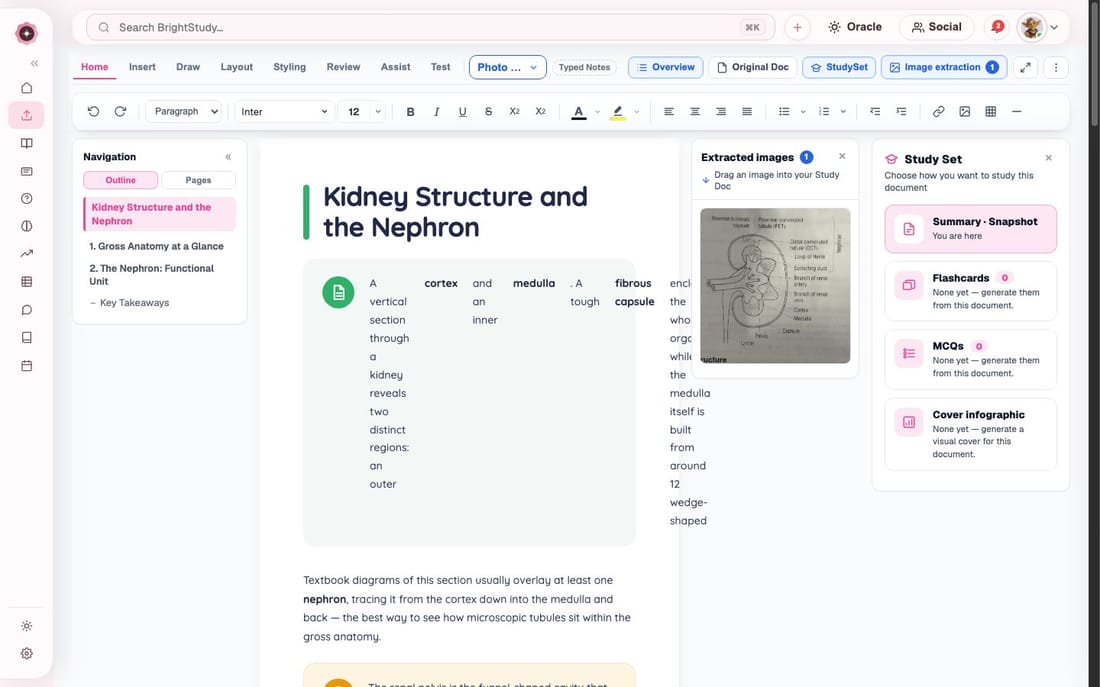
Upload journal articles, lecture slides, PDFs, Word documents, recordings or YouTube talks. BrightStudy turns each into a structured Study Doc with an overview, key concepts and learning objectives that you can edit, annotate and export, and can generate flashcards and questions for exam modules.
Everything is kept in your Vault, organised by module and folder, with figures extracted from your uploads into a reusable image library, so a year of reading stays searchable when the dissertation arrives.
BrightStudy for postgraduate students
Spaced repetition
On paid plans, flashcards and questions come back just before you would forget them, with a daily Due queue across all modules.
Deep Recall
Explain a theory or method in your own words and see how it compares with the key points, useful for seminars, essays and vivas.
Oracle, the AI tutor
On paid plans, ask Oracle to explain a concept or method, or to quiz you on a document you uploaded.
Pro plan tools
The Pro plan adds Deep Dive summaries, mnemonics and memory techniques, fact checking of Study Docs and faster AI processing.
Calendar
Module deadlines, supervision meetings and dissertation milestones in one view.
Any device
Works in the browser on phone, tablet and laptop, ideal for study around work. Mobile apps are coming soon.
A calm study space for long reading sessions
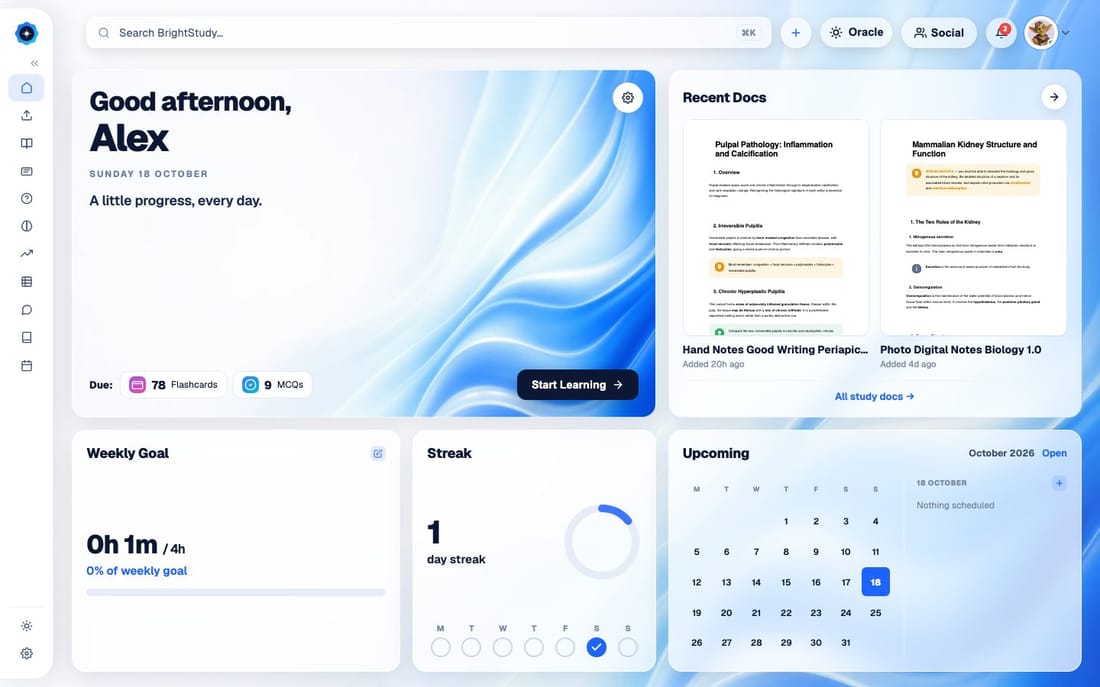
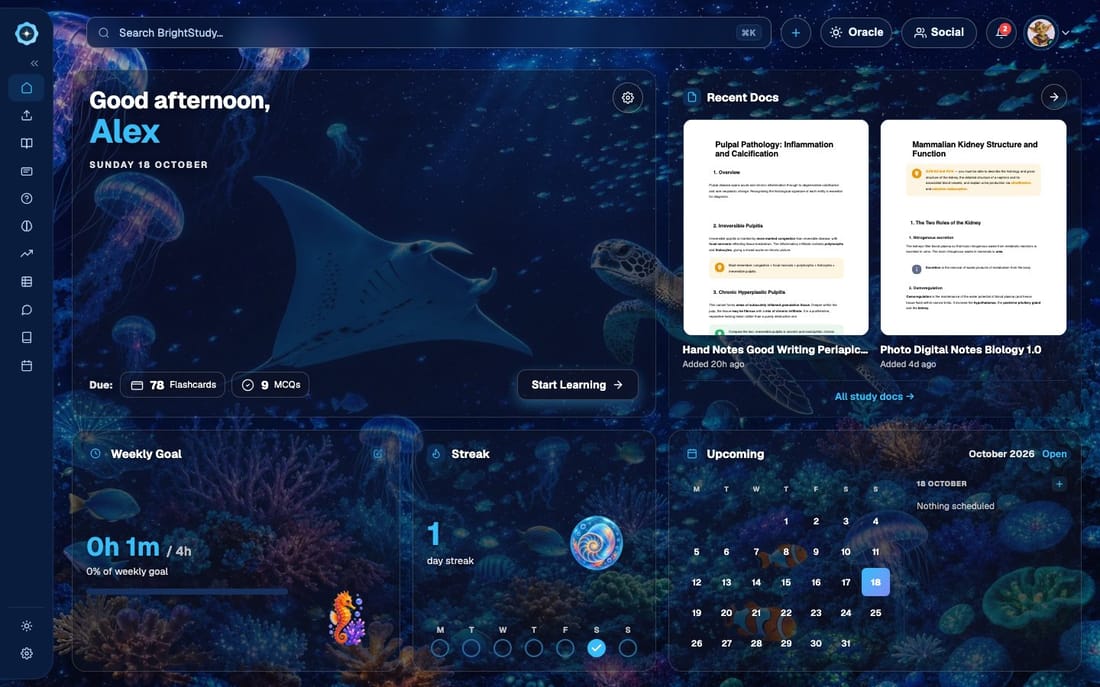
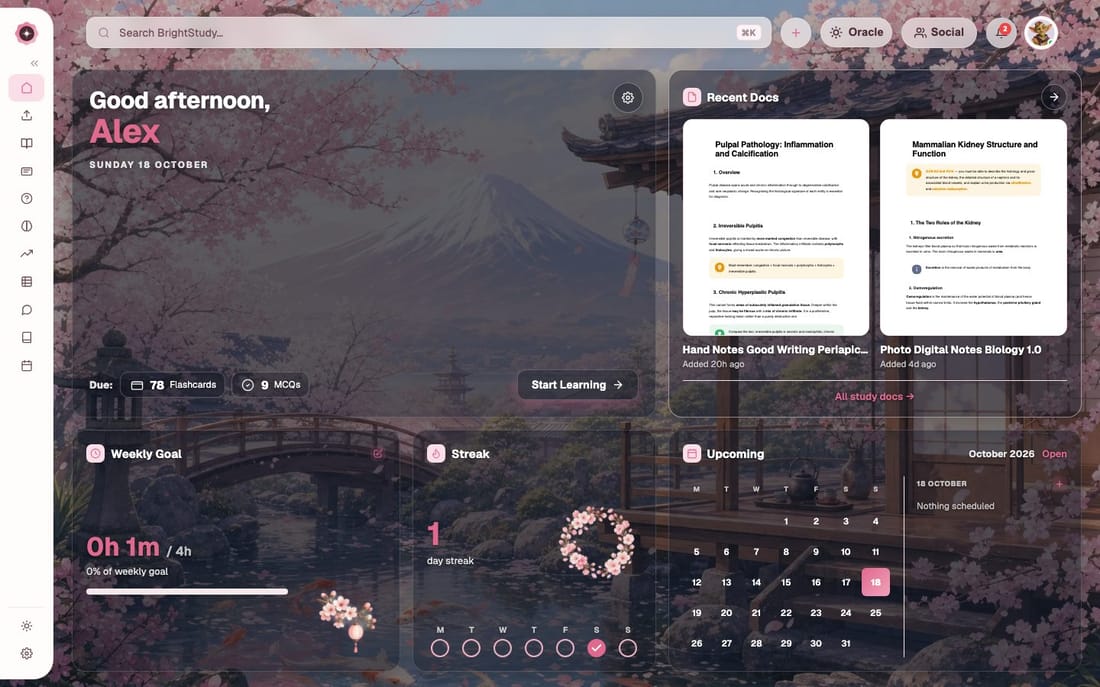
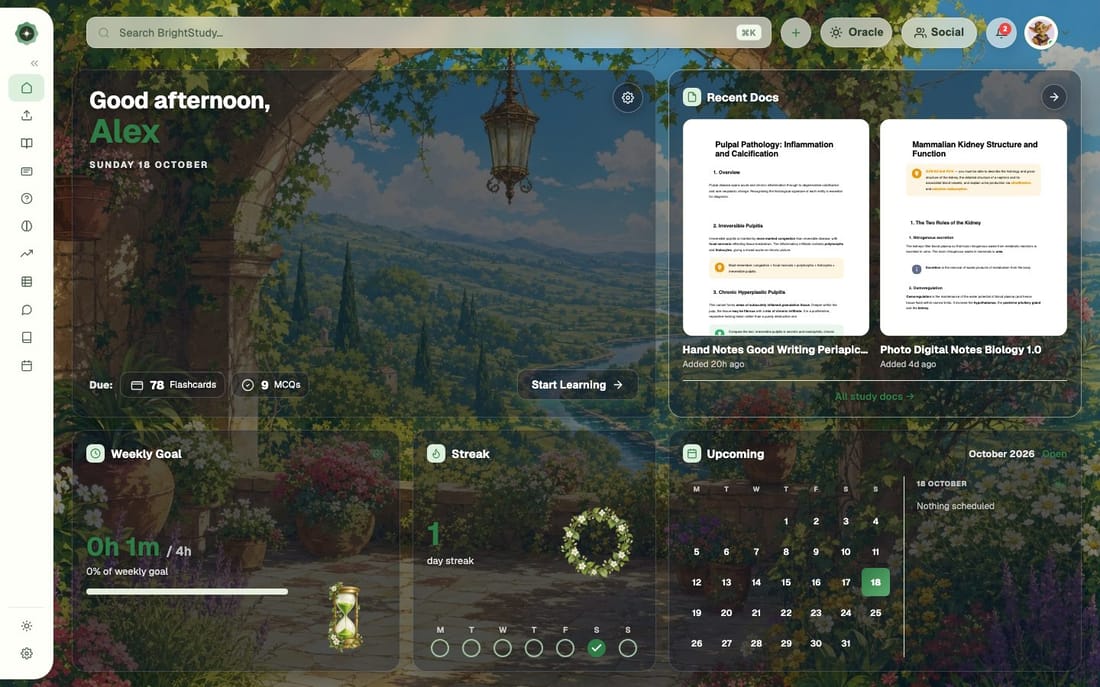
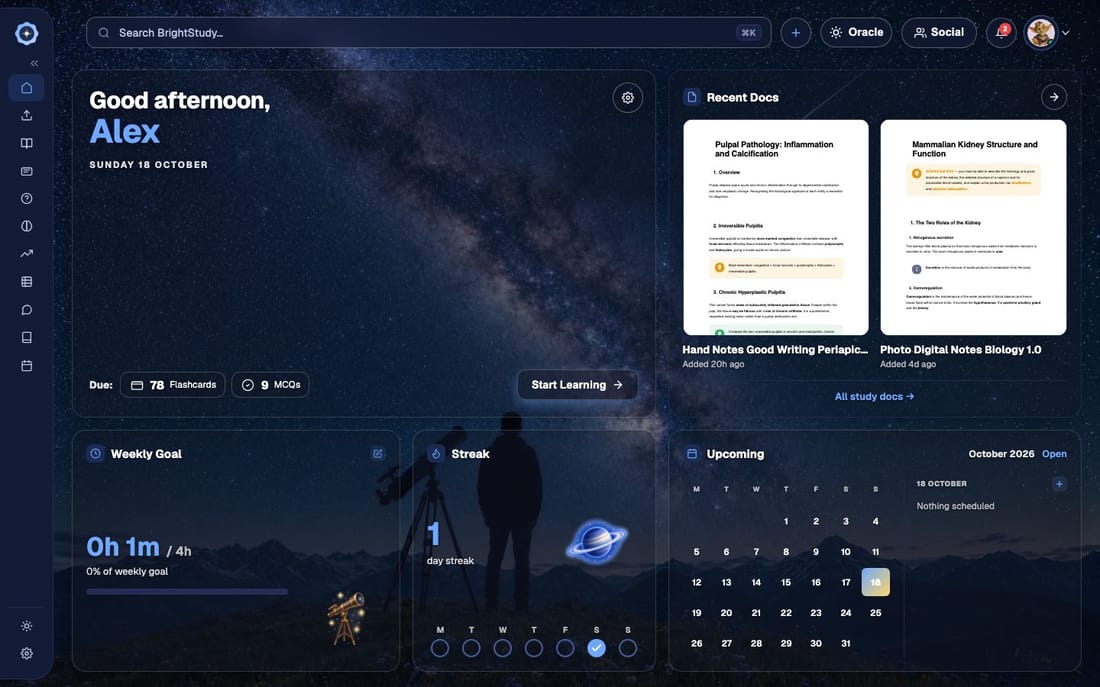
Choose from twelve themes, including dark themes for evening study.
Common postgraduate study mistakes
Underestimating the pace
A one-year master’s leaves little slack. Falling behind in term one makes the dissertation harder.
Description instead of analysis
Summarising the literature is not enough at Level 7. Evaluate, compare and argue.
Reading without notes
Unrecorded reading is lost by the summer. Summarise every source you might cite.
A dissertation question that is too broad
Narrow, answerable questions produce better dissertations than ambitious, vague ones.
Leaving referencing to the end
Record full references as you read. Rebuilding them at the deadline is painful.
Studying in isolation
Peers and supervisors are your best source of feedback. Use seminars and study groups.
Postgraduate study: frequently asked questions
How long is a master’s degree in the UK?
A full-time taught master’s usually takes 12 months, including a summer dissertation. Part-time study usually takes two to three years.
How are master’s degrees graded?
Most are awarded with Distinction (usually 70% or more), Merit (60–69%) or Pass (50–59%). Exact rules vary by university and often include a minimum dissertation mark for a Distinction.
What is the difference between an MSc and an MA?
Broadly, MSc degrees are in sciences and more quantitative subjects and MA degrees in arts, humanities and social sciences, but the naming varies by university. Both are Level 7 master’s degrees.
What is a PGCert or PGDip?
A Postgraduate Certificate is 60 credits and a Postgraduate Diploma is 120. They are shorter postgraduate qualifications, often exit points within a master’s programme.
How long is a master’s dissertation?
Usually between 10,000 and 20,000 words, depending on the subject and university. Your programme handbook will give the exact limit.
Can I do a master’s while working full-time?
Yes. Many UK universities offer part-time and distance-learning master’s programmes designed for working students, usually over two to three years.
How much reading is there on a master’s?
A lot. Expect long reading lists for every module. Read strategically, take notes on arguments and evidence, and focus on the sources most relevant to your assessments.
What is the pass mark for a master’s?
Usually 50% for postgraduate modules, compared with 40% at undergraduate level, though rules vary by university.
Is a master’s harder than a bachelor’s degree?
It is more demanding in pace and depth. A one-year master’s covers advanced material quickly and expects critical, independent work throughout, culminating in a substantial dissertation.
What is an MRes?
A Master of Research: a master’s degree with a larger research component than a taught master’s, often used as preparation for a PhD.
How do I write a good master’s dissertation?
Choose a focused, answerable question, read systematically, justify your methods, write as you go and leave time for editing. Regular meetings with your supervisor, with drafts, keep you on track.
Can I get a master’s with a 2:2?
Many universities ask for a 2:1, but some accept a 2:2, especially with relevant work experience or a strong personal statement. Check individual programme requirements.
Can BrightStudy help me manage my reading?
Yes. Upload papers, slides and lecture recordings and BrightStudy turns them into organised Study Docs in your Vault, with flashcards for the ideas you need to remember. AI generation uses an allowance on the free plan and is fully available on paid plans.
Is BrightStudy free?
You can join for free. Paid plans add spaced repetition, analytics, AI creation and the Oracle tutor, and Pro adds Deep Dive summaries, mnemonics and fact checking; see pricing.
How many hours a week does a full-time master’s take?
Around 35 to 45 hours a week in total is common, including lectures, seminars, reading and coursework. Part-time study is usually around half that.
What is a conversion master’s?
A master’s that lets graduates from another subject qualify in a new field, such as psychology, law, computer science or data science, often with professional accreditation.
Do I need research experience for a master’s?
Not usually for a taught master’s. Research methods are taught as part of most programmes. Research master’s and PhD applications place more weight on research experience.
How do I find a dissertation topic?
Look for questions that came up in your modules, gaps mentioned in recent papers, problems from your own work, and your supervisor’s research interests. Narrow your idea until it can be answered in the time available.
What is a viva?
An oral examination of your research. It is standard for PhDs and used on some master’s programmes, where examiners ask you to explain and defend your work.
Can I study a master’s online?
Yes. Many UK universities offer online and distance-learning master’s degrees, often part-time, with the same qualification as on-campus study.
Other stages of UK study
Keep up with the pace of your master’s
Upload this week’s readings and turn them into notes you can find, and remember, when the dissertation arrives.