University study and degree revision: the complete guide
How a UK degree is structured, how it is assessed and classified, what QAA benchmarks and professional bodies expect, and how to study when the volume of content jumps.
How a UK undergraduate degree works
A bachelor’s degree with honours, such as a BA, BSc, BEng or LLB, usually takes three years full-time in England, Wales and Northern Ireland, and four years in Scotland. Some subjects take longer: integrated master’s degrees such as the MEng, MSci or MPharm take four years, and medicine, dentistry and veterinary science usually take five or six.
Degrees are built from modules worth a number of credits. In England, Wales and Northern Ireland a full-time year is normally 120 credits, and an honours degree is 360 credits in total. Each year sits at a level of the Framework for Higher Education Qualifications (FHEQ): Level 4 in the first year, Level 5 in the second and Level 6 in the final year.
Unlike school, there is no national syllabus. Each university designs its own modules, guided by the QAA subject benchmark statement for the discipline and, for professional degrees, by the standards of bodies such as the GMC, GDC, NMC or HCPC. That is why two degrees in the same subject can feel quite different.

Degree classifications explained: first, 2:1, 2:2 and third
Honours degrees are classified based mainly on your second and final-year marks. Universities set their own weightings and rules, but the bands are broadly the same across the UK.
| Classification | Typical average mark | What it signals |
|---|---|---|
| First-class honours (1st) | 70% and above | Excellent, independent, critical work |
| Upper second-class (2:1) | 60–69% | Very good; the threshold many graduate employers and master’s programmes ask for |
| Lower second-class (2:2) | 50–59% | Good, solid understanding |
| Third-class (3rd) | 40–49% | A pass at honours level |
| Ordinary degree | Below honours threshold | A degree without honours |
Does first year count? At many universities the first year must be passed but carries little or no weight in your final classification. It is still worth doing well: first-year content is the foundation for everything after it, and some employers and placements look at first-year marks.
How university assessment works
University assessment mixes exams, which may be written, online, open-book or practical; coursework such as essays, reports, problem sheets and lab write-ups; presentations and group projects; and, in the final year, often a dissertation or independent project worth a large share of the year’s credits.
Healthcare degrees add clinical assessments. Medicine, dentistry, pharmacy and allied health courses use OSCEs (objective structured clinical examinations), placement assessments and portfolios alongside written exams, and graduates must meet the standards of their regulator to register.
Each module handbook lists learning outcomes: what you should be able to do by the end. They are the closest thing a degree has to a specification, and the best guide to what exams and coursework will test.
Undergraduate subjects, grouped by area
These are the undergraduate subject areas on our UK curriculum map. Each was researched from QAA subject benchmark statements, professional and regulatory standards (such as GMC, GDC, NMC, HCPC, RCVS and the Engineering Council) and published module descriptors from UK universities.
Sciences 6 subjects · QAA, University of Glasgow, RSC, University of Edinburgh, University of Leeds, IOP
English and languages 3 subjects · QAA, University of Edinburgh, University of Glasgow, University of Leeds
Humanities and social sciences 5 subjects · QAA, University of Edinburgh, University of Glasgow, University of Leeds, BPS
Business, law and economics 3 subjects · QAA, University of Edinburgh, University of Glasgow, University of Leeds, Bar Standards Board
Computing, engineering and technology 4 subjects · QAA, ARB, University of Edinburgh, BCS, The Chartered Institute for IT, University of Glasgow, University of Leeds
Medicine, health and care 9 subjects · QAA, HCPC, University of Southampton, University of Gloucestershire, University of the West of England, Social Work England
Arts, media and performance 3 subjects · QAA, University of Edinburgh, NCTJ, University of Glasgow
More subjects 2 subjects · University of Glasgow, QAA, Department for Education, University of Edinburgh, University of Leeds
Professional accreditation: who sets the standards
For regulated professions, a degree must meet the outcomes set by a professional or statutory body before graduates can register or practise.
| Profession | Body | What it sets |
|---|---|---|
| Medicine | General Medical Council (GMC) | Outcomes for graduates; the Medical Licensing Assessment |
| Dentistry | General Dental Council (GDC) | The Safe Practitioner framework of learning outcomes |
| Nursing and midwifery | Nursing and Midwifery Council (NMC) | Standards of proficiency for registration |
| Allied health (physiotherapy, radiography, paramedic science and others) | Health and Care Professions Council (HCPC) | Standards of proficiency for each profession |
| Pharmacy | General Pharmaceutical Council (GPhC) | Standards for initial education and training |
| Veterinary science | Royal College of Veterinary Surgeons (RCVS) | Day One Competences |
| Engineering | Engineering Council (via institutions) | Accreditation of Higher Education Programmes (AHEP) |
| Psychology | British Psychological Society (BPS) | Accreditation standards for undergraduate programmes |
How to revise at university
The challenge at university is volume. A single semester can hold more content than a whole A level, and most of it is examined weeks or months after you first meet it. The methods that work are the same as at school, used consistently.
Process each lecture the same week
Within a few days, turn each lecture into concise notes and a handful of flashcards. Reviewing little and often across the semester is what makes exam season manageable.
Use the learning outcomes as your checklist
Turn every module learning outcome into a question you should be able to answer, and test yourself on it regularly.
Prioritise active recall
Rereading slides feels productive but does little. Flashcards, practice questions and explaining topics aloud build the understanding exams test.
Space reviews across the semester
Revisit topics after days, then weeks. A spaced schedule is the only realistic way to retain anatomy, case law or reaction mechanisms at degree scale.
Practise with past papers and problem sheets
Most departments publish past papers. Work through them under timed conditions and compare against model answers or marking criteria.
Read beyond the slides for top marks
Firsts usually come from wider reading and critical evaluation. Note key papers, arguments and evidence alongside your core content.
Study with others
Explaining material to course mates, quizzing each other and comparing notes exposes gaps quickly.
Start the dissertation early
Choose a topic you care about, agree a plan with your supervisor and write as you go. The final weeks are for editing, not drafting.
Use feedback
Coursework feedback tells you exactly what markers want. Keep a list of recurring comments and act on them in the next assignment.
Protect your wellbeing
Sleep, regular meals, exercise and time off are part of performing well. Universities offer wellbeing and study-skills support; use it early.
From first year to final year
First year
Learn how to learn at university: build a weekly routine, set up a note-taking and flashcard system, and get to grips with academic writing and referencing.
Second year
Marks usually start to count. Deepen your understanding, read more widely and take every chance to practise exam and coursework technique.
Placement or year abroad
If your course includes one, keep a reflective log and collect examples; they are invaluable for applications and final-year work.
Final year
The highest-weighted year, often with a dissertation. Plan backwards from deadlines and keep spaced reviews going for exam modules.
How to take lecture notes that you will actually use
Most lectures come with slides, so there is no point copying them. Instead, listen for what the slides do not say: explanations, examples, emphasis and anything the lecturer says will be important. Annotate the slides or keep brief notes alongside them.
Within a day or two, condense each lecture into a short summary in your own words and turn the key facts into flashcards. That review, while the lecture is still fresh, does more for long-term memory than hours of rereading before the exam.
If lectures are recorded, use recordings to fill gaps rather than re-watching everything; watching at double speed is not the same as studying actively.
University exam formats and how to prepare
| Format | What it tests | How to prepare |
|---|---|---|
| Multiple choice / single best answer | Breadth of knowledge and fine distinctions between options | Large banks of practice questions on a spaced schedule; learn why wrong options are wrong |
| Short answer | Precise recall and explanation | Flashcards and timed short answers against marking criteria |
| Essay exams | Argument, evidence and critical analysis | Essay plans for likely questions, flashcards of evidence and key readings |
| Problem-based / calculation | Applying methods to new problems | Problem sheets and past papers under timed conditions |
| Open-book and online | Application and analysis rather than recall | Well-organised notes you can navigate quickly, and practice with time limits |
| OSCEs and practical exams | Clinical or practical skills and communication | Repeated practice of stations with peers, using the published marking criteria |
Academic writing and referencing
University essays and reports are marked on argument and evidence, not on how much you know. Start with a clear answer to the question, support each point with evidence from reputable sources, consider counter-arguments and finish with a conclusion that follows from what you have shown.
Every source you use must be referenced in the style your department requires, such as Harvard, APA, MHRA or OSCOLA for law. Keep full references as you read; rebuilding them at the deadline is slow and error-prone. Using someone else’s words or ideas without acknowledgement is plagiarism and is treated seriously.
Read your feedback carefully and keep a list of recurring comments. Most students who move from a 2:2 to a 2:1, or a 2:1 to a first, do it by acting consistently on feedback.
Getting support at university
Personal tutor
Your first point of contact for academic questions, extensions and general advice. Meet them early, before you need help.
Academic skills services
Most universities offer free workshops and one-to-one help with essay writing, referencing, maths and revision.
Library and subject librarians
Experts in finding sources for essays and dissertations, and in using databases effectively.
Wellbeing and disability services
Support for mental health, disabilities and specific learning differences, including exam adjustments.
Getting the most from seminars, labs and group projects
Seminars and tutorials are where you test your understanding in discussion. Do the reading beforehand, note two or three questions or points you want to raise, and speak early, which gets easier with practice. Afterwards, add anything new you learned to your notes and flashcards.
Labs and practical classes are often examined, directly or in exam questions. Write up methods and results promptly and make sure you understand why each step matters.
Group projects test teamwork as much as subject knowledge. Agree roles, deadlines and how you will communicate at the start, and keep a record of who did what in case it is needed.
Planning your undergraduate dissertation
Pick a topic you care about
You will spend months on it. Choose something that interests you, fits your supervisor’s expertise and can be researched with the time and resources you have.
Write a short proposal
Set out your question, why it matters, the main literature and how you will answer it. Agree it with your supervisor before you start.
Build a timeline
Work backwards from the deadline with dates for reading, data collection, analysis, a full draft and editing.
Read and note as you go
Summarise each source and keep full references. Your notes become your literature review.
Draft chapter by chapter
Write each section as you finish the related work. Share drafts with your supervisor and act on feedback.
Leave time to edit
At least two weeks for restructuring, tightening your argument, checking references and formatting.
Placements, internships and building experience
Many degrees offer a placement year or summer internships, and professional degrees such as medicine, nursing and education include extended placements. They build experience, help you decide on a career and often lead to graduate job offers.
Treat a placement as part of your learning: set goals, keep a reflective log, and connect what you see at work to what you studied. Those reflections are valuable for final-year projects, job applications and professional portfolios.
Making the jump from school or college to university
The biggest change at university is responsibility. There is no teacher checking homework each week, and many modules are assessed only at the end of a semester, so it is easy to feel that you are keeping up when you are not. Building your own weekly routine from the first week, with time for each module, is the single most useful habit you can form.
Contact hours are often lower than at school, but expected study hours are higher. A lecture is the start of learning a topic, not the end: the reading, problem sheets and your own notes and flashcards are where most of the learning happens. Students who treat independent study as part of their timetable, rather than something to fit in, settle in fastest.
University also asks for a new kind of thinking. Instead of learning the right answer, you are asked to weigh evidence, compare arguments and form your own view, then defend it. It takes time to get used to, and feedback on your first assignments is the quickest way to learn what your lecturers expect.
Turn lectures, slides and readings into study material
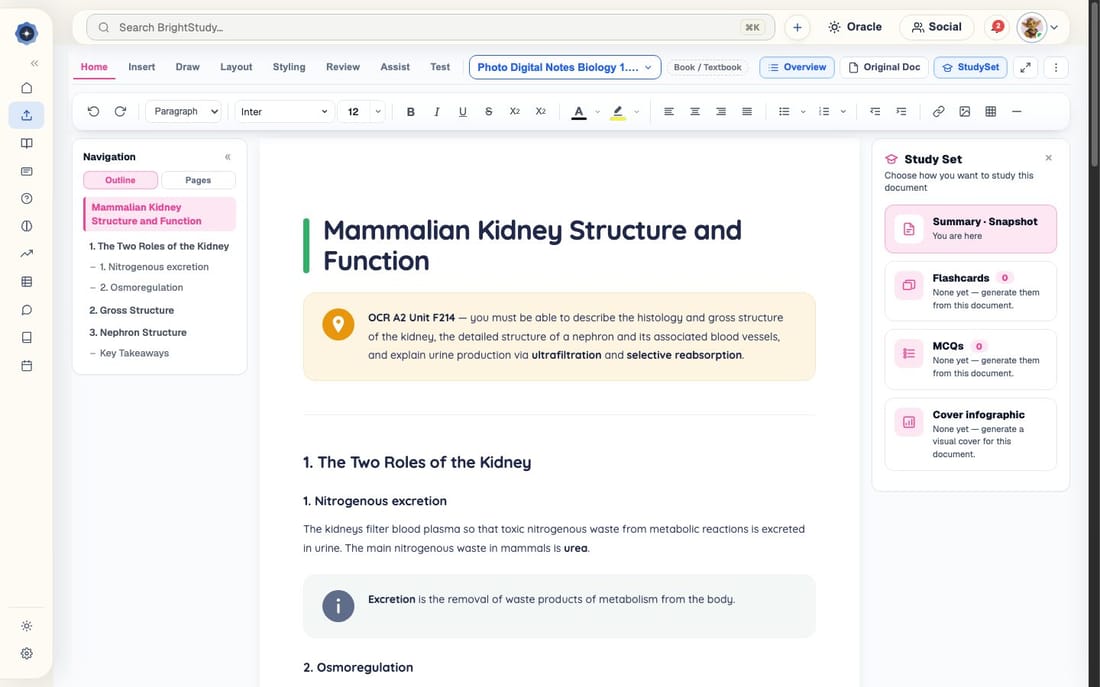
Upload what your course gives you: lecture slides, PDFs, Word documents, photos of handwritten notes, audio recordings and YouTube lectures. BrightStudy turns each into a structured Study Doc with an overview, learning objectives, key concepts and diagrams, which you can edit, annotate and export.
From the same material it can write active-recall flashcards and single-best-answer style questions, with clinical vignettes and plausible distractors where the subject calls for them. Every question passes automated checks and a separate AI review before you see it, and comes with an explanation of the right and wrong answers.
Keep a whole degree in your memory
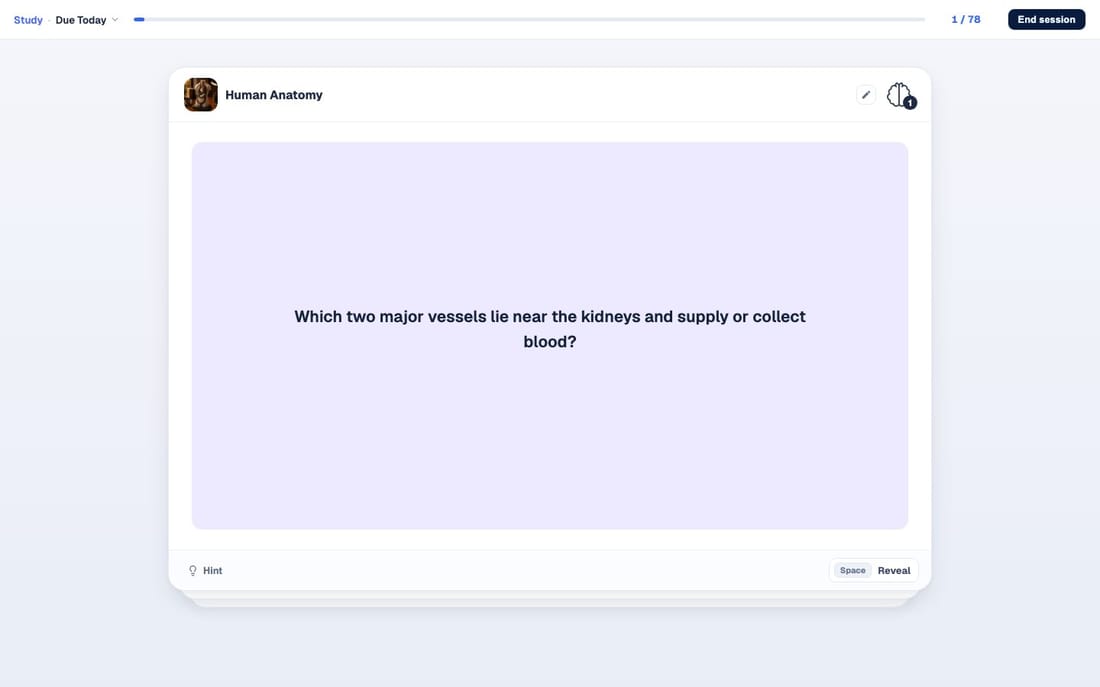
On paid plans, an FSRS-based scheduler brings every flashcard back just before you would forget it, adapting to how you actually remember. A daily Due queue covers every module, and you can tune your target recall rate in Settings.
Questions use the same schedule. Answer one correctly twice in a row and BrightStudy writes a new version of it on the same learning target, so you prove understanding rather than recognising a familiar question. Progress shows your accuracy on first attempts at new versions.
More BrightStudy tools for university students
Vault
Your whole degree in one place: documents, images, recordings and videos in folders by module, with diagrams extracted into a reusable image library. Deleted items stay recoverable for 30 days.
Deep Recall
Explain a concept in your own words and see how your answer measures up against the key points, ideal for essays and vivas.
Community Library
Study Docs, flashcards and MCQs from BrightStudy and other students, organised by subject, course and topic, each approved by an admin before publishing. Share your own under a public username.
Oracle, the AI tutor
On paid plans, ask Oracle to explain a topic, quiz you or help you work through a document you have uploaded.
Progress analytics
On paid plans, topic strength from your real performance, trends over time, streaks and weekly goals.
Calendar
Exams, coursework deadlines, placements and study sessions in one view.
Learn beyond your own notes
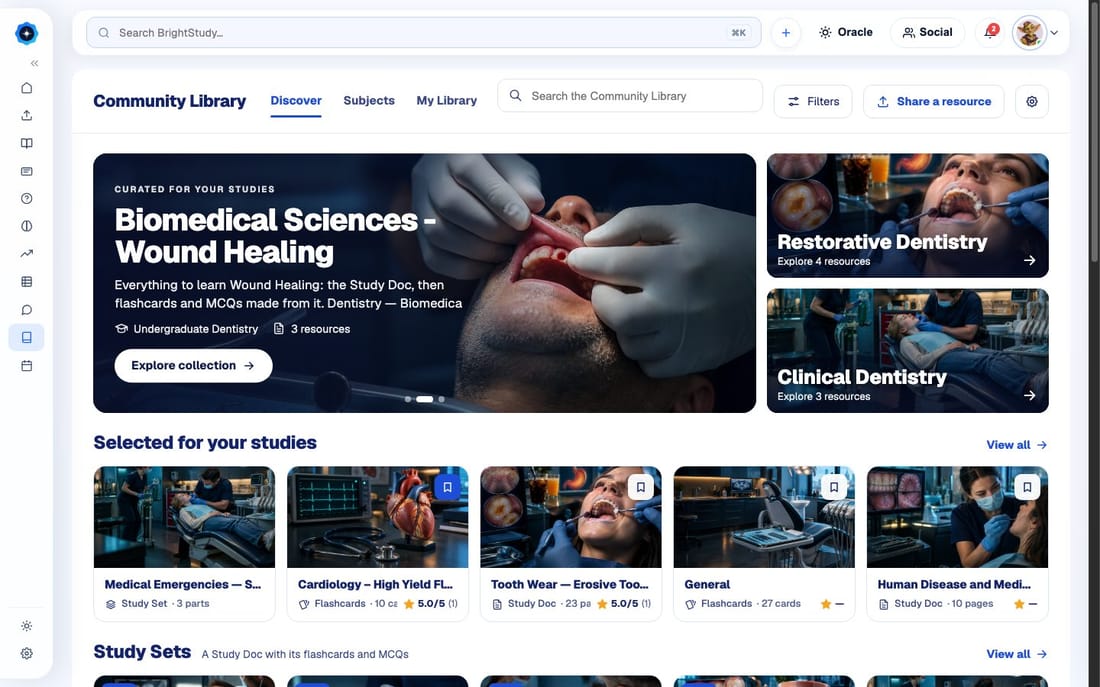
The Community Library collects reviewed study resources, including complete Study Sets that pair a Study Doc with matching flashcards and questions. Browse by subject, course and topic, preview resources and add them to your own Vault.
Every submission passes automated checks and a safety triage, and nothing is published until a BrightStudy admin approves it. When you publish your own material, it appears under a public username; your real name is never shown.
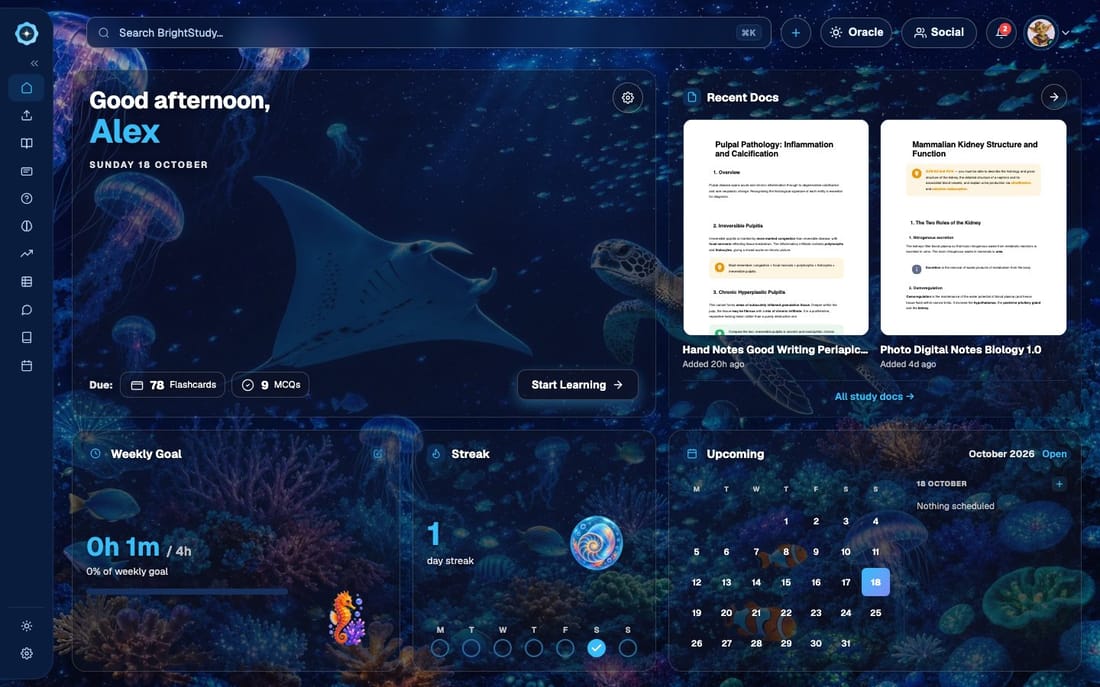
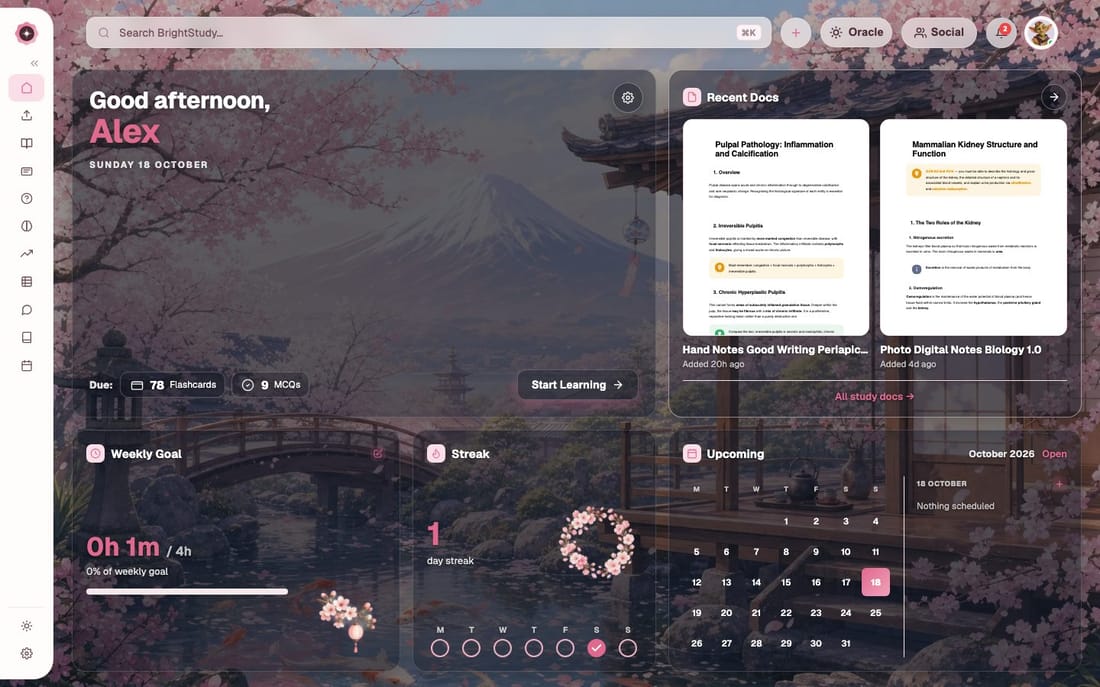
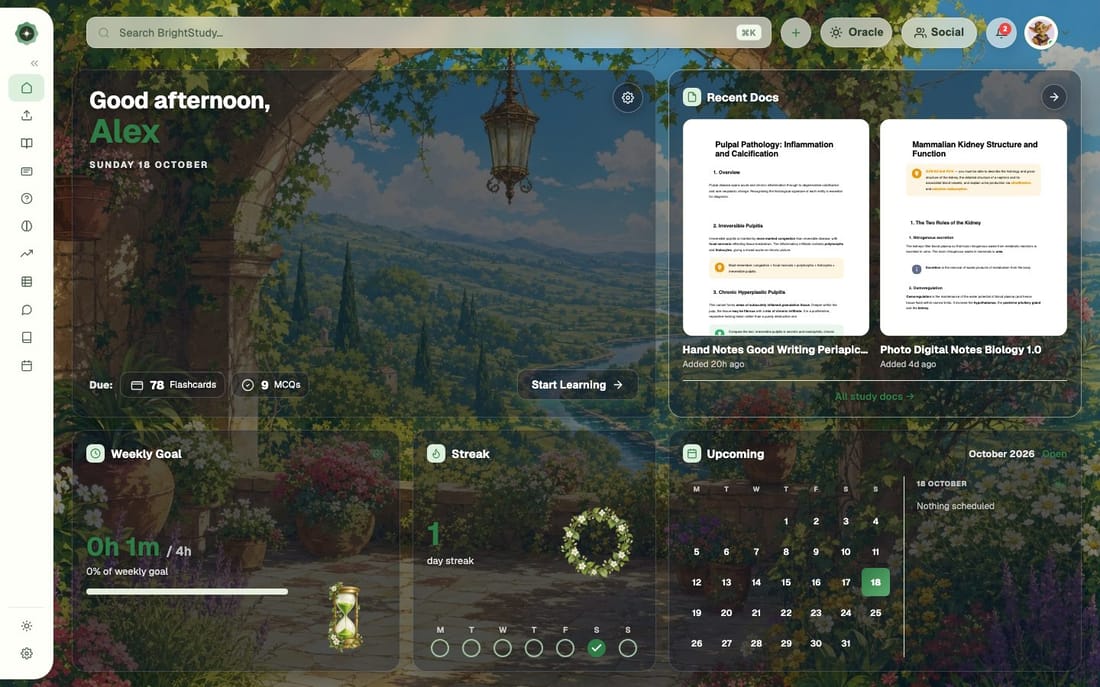
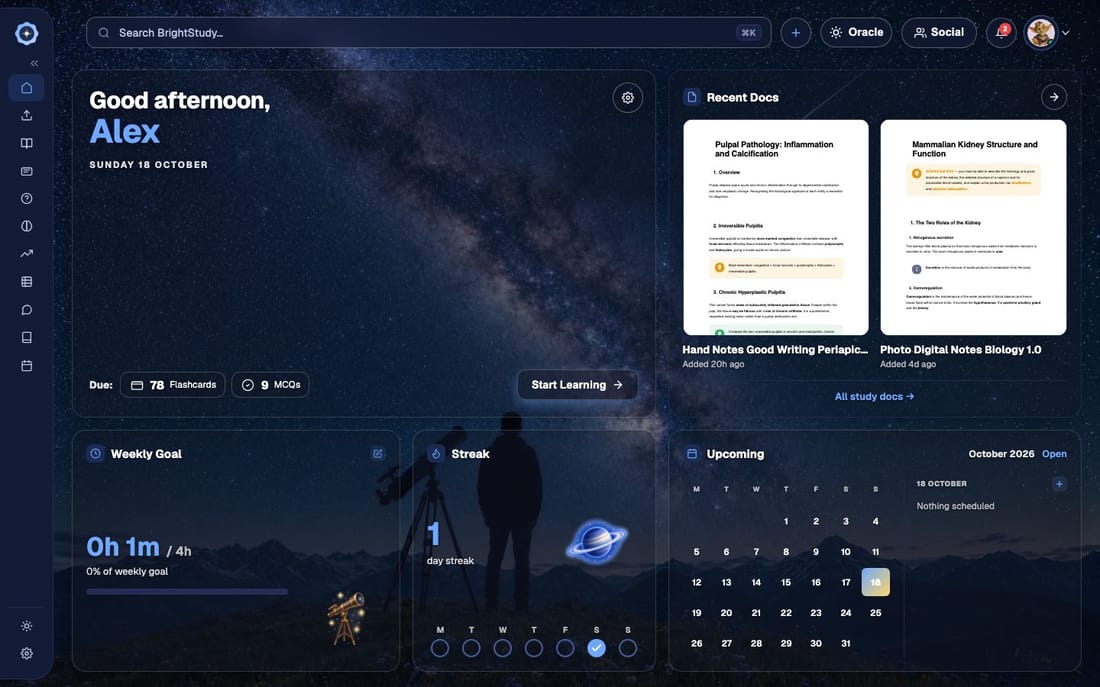
Twelve themes for long study sessions
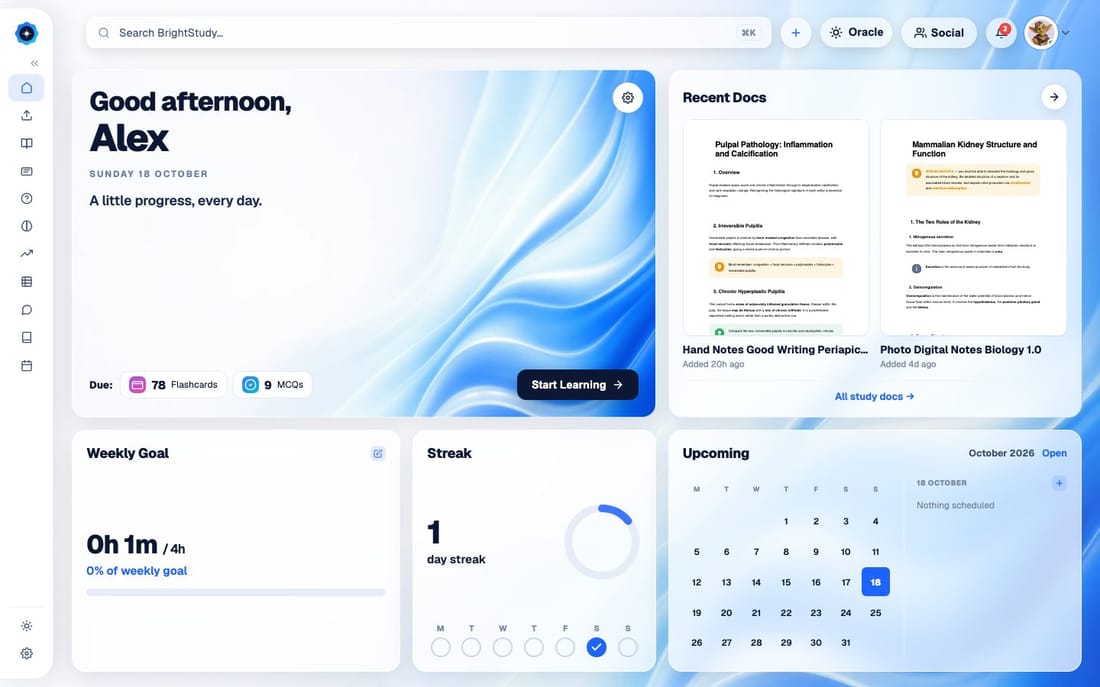
From bright daytime themes to dark ones for late nights in the library, your theme changes the whole of BrightStudy.
Common university study mistakes
Falling behind on lectures
Recorded lectures make it easy to postpone. Unwatched lectures pile up fast; keep to a weekly schedule.
Cramming in exam season
A semester of content cannot be learned in two weeks. Spaced review from week one is far less stressful.
Ignoring learning outcomes
They tell you what will be assessed. Revising without them risks gaps.
Not using feedback
Feedback is free coaching. Students who act on it improve fastest.
Studying alone all the time
Course mates are a resource. Quizzing each other is efficient and motivating.
Leaving the dissertation late
It is usually the biggest single piece of work. Start early and write steadily.
University study: frequently asked questions
How are UK degrees graded?
Honours degrees are classified as first class (usually 70% and above), upper second (2:1, 60–69%), lower second (2:2, 50–59%) or third (40–49%), based mainly on second and final-year marks. Each university sets its own weighting rules.
Does first year count at university?
At many universities, first-year marks must be passed but do not count, or count very little, towards the final classification. Check your programme handbook; some courses, especially integrated master’s and professional degrees, do count first year.
How many credits is a UK degree?
An honours bachelor’s degree in England, Wales and Northern Ireland is normally 360 credits, 120 per year. In Scotland, a four-year honours degree is 480 credits.
What is a QAA subject benchmark statement?
A document from the Quality Assurance Agency describing what graduates in a subject should know and be able to do. Universities use them when designing and reviewing degrees.
How should I revise for university exams?
Process each lecture within days, test yourself with flashcards and practice questions throughout the semester on a spaced schedule, use module learning outcomes to guide your revision and do timed past papers before exams.
What is the difference between a 2:1 and a 2:2?
A 2:1 usually means an average of 60–69% and a 2:2 an average of 50–59%. Many graduate schemes and master’s programmes ask for a 2:1, though requirements vary.
Can BrightStudy make flashcards from my lecture slides?
Yes. Upload slides, PDFs, Word documents, handwritten notes, recordings or a YouTube lecture and BrightStudy can create a Study Doc, flashcards and exam-style questions. AI generation uses an allowance on the free plan and is fully available on paid plans.
Does BrightStudy work for medicine, dentistry and nursing?
Yes. Questions can be written in single-best-answer style with clinical vignettes, shaped by your study profile so the depth matches your stage. Our curriculum research for these subjects draws on the GMC, GDC and NMC standards and published university curricula.
Can I share study materials with my course mates?
You can publish resources to the Community Library under a public username, and browse reviewed resources others have shared. Every resource is approved by an admin before it is published.
How many hours should I study at university?
A common guide is around 10 hours of total study per credit, so a 120-credit year means roughly 1,200 hours, or about 35 to 40 hours a week during term including lectures. Courses vary, so check your programme handbook.
How do I get a first-class degree?
Consistently strong work in the years that count: critical, well-evidenced coursework that acts on feedback, wide reading beyond the core material, and exam preparation spread across the whole semester with active recall and timed practice.
What is an integrated master’s?
A four-year degree such as an MEng, MSci or MPharm that combines undergraduate and master’s-level study, ending with a master’s qualification.
What are OSCEs?
Objective structured clinical examinations: practical assessments in medicine, dentistry, nursing and allied health in which students rotate through timed stations testing clinical skills and communication.
What happens if I fail a module?
Most universities allow a resit or resubmission, often over the summer, sometimes with the mark capped at the pass mark. Rules vary, so check your university’s regulations and talk to your personal tutor.
Is there a free plan for students?
Yes. The free plan includes unlimited flashcards, MCQs and Study Docs you create yourself and a taste of the AI tools. Paid plans add spaced repetition, analytics, AI creation and the Oracle tutor; see pricing.
How should I take notes in lectures?
Annotate the slides rather than copying them, focusing on explanations and examples the lecturer adds. Within a day or two, summarise the lecture in your own words and turn key facts into flashcards.
What referencing style should I use?
Use the style your department specifies, such as Harvard, APA, MHRA or OSCOLA for law. Your module handbook or library guide will tell you which one and how to apply it.
How do I prepare for open-book exams?
Organise your notes so you can find information quickly, practise answering questions within the time limit, and focus on applying and analysing information rather than copying it.
Is a placement year worth it?
For many students, yes. Placements build experience, help with career decisions and often lead to graduate job offers, and many students find their final-year studies benefit from the experience.
How do I stay on top of a heavy reading list?
Prioritise core readings, read strategically by starting with abstracts and conclusions, take notes on arguments and evidence, and schedule reading into your weekly routine rather than leaving it to exam season.
Other stages of UK study
Your whole degree. One learning system.
Upload this week’s lectures and turn them into notes and flashcards you will actually review.