GCSE revision: the complete guide
How GCSEs work, what each grade means, every subject and exam board, and the revision methods that actually raise grades, with study tools to put them into practice.
How GCSEs work
GCSEs (General Certificates of Secondary Education) are the qualifications most students in England, Wales and Northern Ireland take at the end of Key Stage 4. Courses usually run across Year 10 and Year 11, and almost all of the assessment happens in one exam season in May and June at the end of Year 11, when students are 15 or 16.
Most students take somewhere between eight and ten GCSEs. English language, English literature, maths and science are taken by nearly everyone, alongside a mix of options chosen in Year 9, such as history or geography, a modern foreign language, computer science, art, music or religious studies.
Since the reforms that began in 2015, GCSEs in England are linear: you sit every exam at the end of the course rather than banking modules along the way. That makes the final few months important, but it also means revision that starts early and builds steadily is far more effective than a last-minute cram.
Some subjects include assessed coursework, called non-exam assessment (NEA): a design project in design and technology, a portfolio in art, or performances in drama, dance and music. Science subjects include required practicals that you carry out in class and are then tested on in the written exams.

GCSE grades explained: what 9 to 1 means
In England, GCSEs are graded on a numbered scale from 9 (highest) to 1, with U for ungraded. The numbers replaced the old A* to G letters, and the top grades were spread out so that a 9 is harder to reach than the old A*. Wales and Northern Ireland use their own systems, described below.
| Grade | What it means | Roughly comparable to the old letters |
|---|---|---|
| 9, 8, 7 | High grades. Grade 7 is the bottom of the top band. | A* and A |
| 6, 5 | Good grades. Grade 5 is a “strong pass”, used in school performance tables. | B and high C |
| 4 | Grade 4 is a “standard pass”, the level most employers, colleges and sixth forms look for. | C |
| 3, 2, 1 | Passes below the standard level. | D, E, F and G |
| U | Ungraded. | U |
Combined Science is worth two GCSEs and uses a 17-point double grade, from 9–9 down to 1–1 (for example 6–5 or 4–4). Students taking separate Biology, Chemistry and Physics, often called triple science, get three separate grades.
In England, students who do not reach grade 4 in English or maths must keep studying the subject after Year 11, usually resitting the GCSE at college or sixth form. That is one reason English and maths revision deserves steady attention throughout Year 10 and Year 11.
Foundation tier or Higher tier?
Some GCSEs are tiered: maths, the sciences and modern foreign languages each have a Foundation paper and a Higher paper. Your school decides which tier you are entered for, usually after mock exams in Year 11.
Foundation tier covers grades 1 to 5. Higher tier covers grades 4 to 9, with an allowed grade 3 for students who just miss grade 4. Higher papers include extra content, such as more demanding algebra in maths or additional chemistry and physics calculations, and it is clearly marked as “higher tier only” in each specification.
If you are on the boundary, the most useful thing you can do is make sure the shared content is completely secure. The topics on both tiers are where most marks come from, so strong foundations matter whichever paper you sit.
Every GCSE subject, grouped by area
Below is every GCSE subject on our UK curriculum map, grouped by area. We researched each one from the official documents that define it: the Department for Education’s GCSE subject content and the current specifications published by the exam boards. Where a subject is only offered by one board, such as GCSE Astronomy (Pearson Edexcel) or Ancient History (OCR), that is the board listed.
The EBacc (English Baccalaureate) is a group of subjects the government encourages: English language and literature, maths, the sciences, a language, and history or geography. It is a school performance measure rather than a qualification, but many schools build their options around it.
Sciences 7 subjects · Pearson Edexcel, Department for Education, AQA, OCR, WJEC Eduqas, Cambridge International Education
Maths and statistics 2 subjects · AQA, Department for Education, Pearson Edexcel, OCR
English and languages 7 subjects · Department for Education, OCR, WJEC Eduqas, AQA, Pearson Edexcel
Humanities and social sciences 7 subjects · Department for Education, OCR, AQA, Pearson Edexcel, WJEC Eduqas
Business, law and economics 3 subjects · Department for Education, AQA, OCR, WJEC Eduqas, Pearson Edexcel
Computing, engineering and technology 3 subjects · Department for Education, AQA, OCR, Pearson Edexcel, WJEC Eduqas
Medicine, health and care 5 subjects · NCFE CACHE, AQA, Department for Education, OCR, Pearson Edexcel
Arts, media and performance 7 subjects · Department for Education, AQA, OCR, WJEC Eduqas, WJEC, Pearson Edexcel
GCSE exam boards: AQA, OCR, Pearson Edexcel and WJEC Eduqas
Every GCSE is set and marked by an exam board, and each board publishes a specification: the official document that lists every topic you can be examined on, the skills you need and how the papers are structured. In England the main boards are AQA, OCR, Pearson Edexcel and WJEC Eduqas. Your school chooses the board for each subject, and it is often different from one subject to the next.
All boards in England follow the same Department for Education subject content, so the core of a subject is shared. The differences are in how topics are grouped, the set texts and case studies, the exam structure and the style of questions. That is why knowing your board matters: revising from the right specification means no wasted time on content you will not be tested on.
In Wales, GCSEs are made for Welsh learners by WJEC and are graded A* to G. In Northern Ireland, CCEA GCSEs use a nine-grade A* to G scale that includes a C* grade. Scotland has its own qualifications, the National 4 and National 5.
How to revise for GCSEs: 10 methods backed by evidence
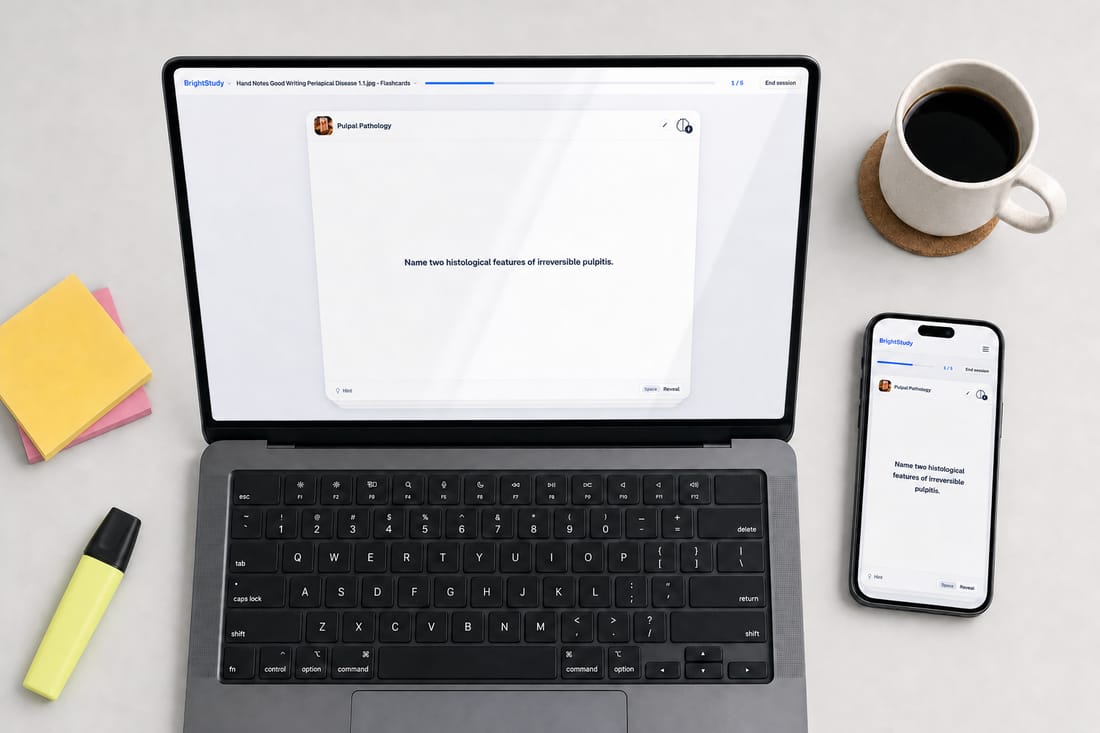
Decades of research on learning point to a small number of techniques that reliably improve exam results. The common thread is that you learn by retrieving information, not by rereading it. Here is how to apply that to GCSE revision.
Turn the specification into a checklist
Download the specification for each subject, list every topic and rate your confidence red, amber or green. Spend most of your time on red and amber topics and keep green ones fresh with quick reviews.
Test yourself before you reread
Start each session by answering questions on a topic from memory: flashcards, past-paper questions or a blank-page brain dump. Then check your notes. The effort of remembering is what makes knowledge stick.
Space your reviews out
Come back to each topic after a day, a few days, then a week or two. Spreading reviews over time beats cramming the same material in one long session, and it is the best protection against forgetting before the exam.
Mix topics within a session
Instead of doing twenty questions on one maths topic, mix several topics. Interleaving feels harder but trains you to recognise which method a question needs, exactly what the exam demands.
Make flashcards for facts, formulas and quotes
Key terms, equations, dates, vocabulary and English literature quotations are perfect for flashcards. Keep each card to one idea, and write the question so it makes you recall, not recognise.
Practise exam questions under timed conditions
Exam technique is a skill of its own. From Year 11, regularly do full questions in the time you would have in the exam, then mark them honestly against the mark scheme to see what examiners reward.
Explain it out loud
If you can teach a topic to someone else, or to an empty room, you understand it. Gaps in your explanation show you exactly what to revise next.
Revise required practicals properly
In biology, chemistry and physics, questions on required practicals are common. Learn the method, the variables, the safety points and how to analyse the results for each one.
Use your mock results as data
Mocks show which topics and question types cost you marks. List them, turn them into flashcards and practice questions, and revisit them in the weeks that follow.
Look after sleep and breaks
Memory is consolidated during sleep, and attention fades in long sessions. Work in focused blocks of 25 to 45 minutes with short breaks, and keep regular sleep through exam season.
What to focus on in each term of your GCSE years
GCSE revision is a two-year project. Spreading the work out is the single biggest advantage you can give yourself, and each term has a slightly different job.
Year 10, autumn and spring
Build the habit. After each lesson, turn what you learned into a few flashcards and review your due cards for 10 to 15 minutes a day. Topics reviewed now need far less relearning later.
Year 10, summer
Many schools hold end-of-year exams. Treat them as practice mocks: make a timetable, test yourself and use the results to find weak topics before Year 11 begins.
Year 11, autumn
Finish any coursework or NEA early, keep daily reviews going and start timed exam questions in each subject so the format feels familiar by mock season.
Year 11, mocks
Mocks usually fall between November and February. Revise for them properly; they are the most realistic rehearsal you will get and often decide tiers and predicted grades.
Year 11, spring
Switch to a full revision timetable built from your mock results. Prioritise red topics, keep every subject ticking over and add a weekly full past paper.
Exam season
Revise subject by subject in the order of your exams, focusing on retrieval and timed practice, and protect your sleep. Most GCSE exams finish by late June.
A sample GCSE revision timetable
A good GCSE revision timetable is realistic, repeats each subject several times a week and leaves room for rest. This example is for a Year 11 student in the spring term, studying around school. Adjust it for your own subjects and commitments.
| Day | Session 1 (40 min) | Session 2 (40 min) | Quick review (15 min) |
|---|---|---|---|
| Monday | Maths: mixed practice questions | Biology: required practicals | Flashcards due today |
| Tuesday | English literature: quotations and themes | Chemistry: calculations | Flashcards due today |
| Wednesday | History: timed exam question | French: vocabulary and listening | Flashcards due today |
| Thursday | Maths: past-paper section | Physics: equations and units | Flashcards due today |
| Friday | English language: reading paper practice | Option subject | Flashcards due today |
| Saturday | A full timed paper in one subject | Mark it and log the mistakes | Rest |
| Sunday | Rest, or light review of red topics | — | Plan the week ahead |
Notice that every day starts with retrieval and ends with a short review of what is due, rather than with rereading notes. In the final weeks before the exams, swap more sessions for timed papers and focus your reviews on the topics that keep coming up red.
GCSE revision tips for the main subjects
The core methods apply everywhere, but each subject rewards something slightly different. Here is where to focus in the subjects almost everyone takes, and in the most popular options.
GCSE maths
Maths is learned by doing. Work through mixed sets of questions rather than one topic at a time, and keep a log of every question you get wrong with the correct method written out. Return to that log every week. Make sure the formulas you must memorise are on flashcards, and practise non-calculator arithmetic regularly, because every board includes a non-calculator paper.
Problem-solving questions often combine two or three topics. When you check an answer, ask which clue in the question should have told you which method to use; that habit is what turns a grade 5 into a 7.
GCSE English language
There is no content to memorise in the usual sense, so revision means practising the skills: reading unseen extracts quickly, identifying language and structure techniques, and writing analysis that explains their effect. Time yourself on each question type and compare your answers against the mark scheme’s levels.
For the writing sections, plan a handful of strong openings, structures and vocabulary you can adapt, and practise writing to time so your best work fits in the exam.
GCSE English literature
Learn short, flexible quotations for each character and theme in your set texts, and practise linking them to context and the writer’s methods. Flashcards are ideal: put the theme or character on the front and two or three quotations with a line of analysis on the back.
Most papers are closed book, so recall matters. Practise essay plans as much as full essays; a five-minute plan for every likely question is an efficient way to cover a whole text.
GCSE biology, chemistry and physics
Science exams test knowledge, application and maths skills. Use flashcards for definitions, processes and the equations you must recall, then practise applying them to unfamiliar contexts with exam questions. Make one flashcard set for each required practical covering method, variables, risks and typical results.
In chemistry and physics, practise calculations until rearranging equations and handling units is automatic. Many marks are lost not on the science but on the maths.
GCSE history and geography
Both reward specific, accurate detail. For history, build timelines and flashcards of key dates, people and evidence, then practise each question type, especially source and interpretation questions, against the mark scheme. For geography, learn your named case studies with real facts and figures, and practise skills questions on maps, graphs and data.
GCSE modern foreign languages
Vocabulary is the foundation of every paper, so review it daily with spaced repetition. Practise listening with authentic audio, rehearse answers to likely speaking topics aloud, and learn a bank of flexible phrases and tenses you can use in writing. The 2024 reforms to French, German and Spanish GCSEs put more weight on high-frequency vocabulary, so a well-reviewed core list pays off.
GCSE religious studies, computer science and business
These options mix knowledge recall with extended answers. Use flashcards for key terms, beliefs, programming concepts or business formulas, then practise the longer evaluation questions, which carry the most marks. In computer science, practise tracing and writing code by hand, because some exam questions require it without a computer.
GCSE exam day: how to perform at your best
The night before
Do a short review of your key flashcards, pack your equipment (black pens, pencil, ruler, calculator, clear pencil case, water) and get a full night’s sleep instead of a late cram.
Read the whole paper first
Check how many questions there are and how many marks each carries, then plan your time roughly one minute per mark, leaving a few minutes to check.
Answer the question asked
Underline command words such as describe, explain, compare or evaluate. Each asks for something different, and examiners can only reward what the question requires.
Show your working
In maths and science, method marks are often available even if the final answer is wrong. Write every step clearly.
Do not get stuck
If a question stalls you, mark it, move on and come back. Easy marks later in the paper are worth the same as hard marks now.
Let it go afterwards
Once a paper is finished, avoid long post-mortems with friends. Rest, eat and turn your attention to the next exam.
After GCSEs: A levels, T Levels, BTECs and apprenticeships
In England, young people must stay in education or training until 18. After GCSEs, the main routes are A levels at a school sixth form or college, usually three subjects over two years; T Levels, two-year technical courses equivalent to three A levels that include a substantial industry placement; vocational qualifications such as BTEC Nationals; and apprenticeships, which combine paid work with study.
Entry requirements vary, but grade 4 or 5 in English and maths is commonly asked for, and many sixth forms want a grade 6 or higher in any subject you plan to take at A level. Read our guides to A level revision and BTEC, T Level and further education to see what each path involves.
Turn your GCSE notes into flashcards and practice questions
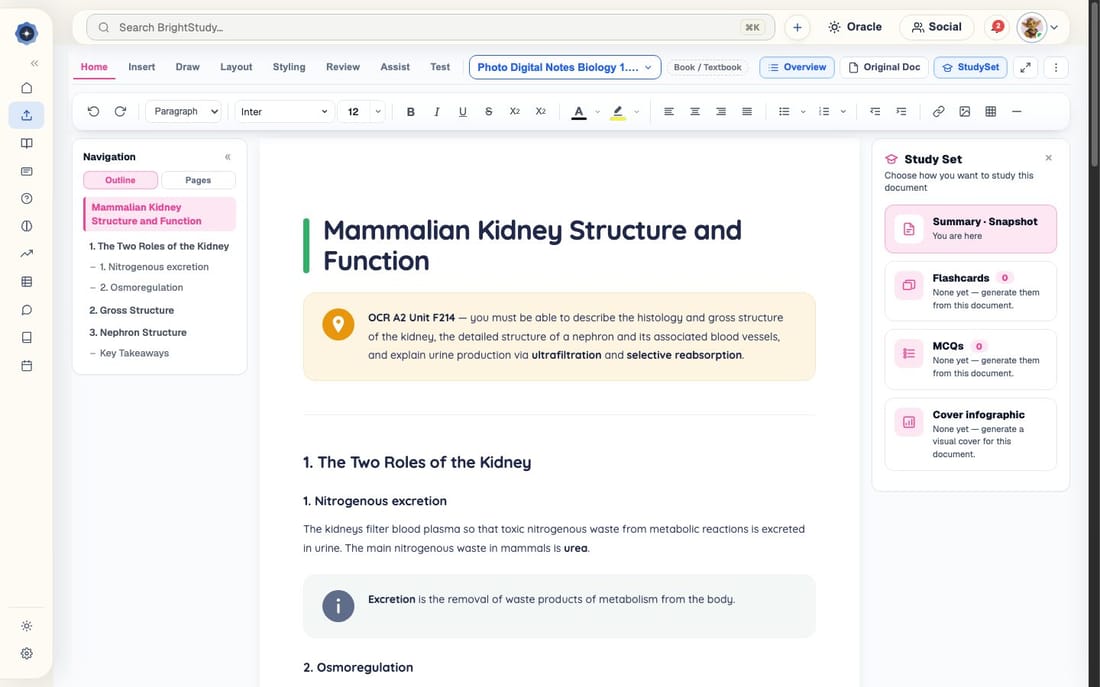
BrightStudy is a study system built around the methods above. Upload what you already have: class notes, PDFs, slides, Word documents, photos of handwritten notes or a YouTube lesson. BrightStudy turns each one into a structured Study Doc with an overview, key concepts and learning objectives that you can edit and annotate.
From the same material it can generate active-recall flashcards and exam-style multiple-choice questions, each checked by a separate AI reviewer before you see it. You can also write your own flashcards and questions by hand, which is unlimited on the free plan.
Flashcards that come back at the right time
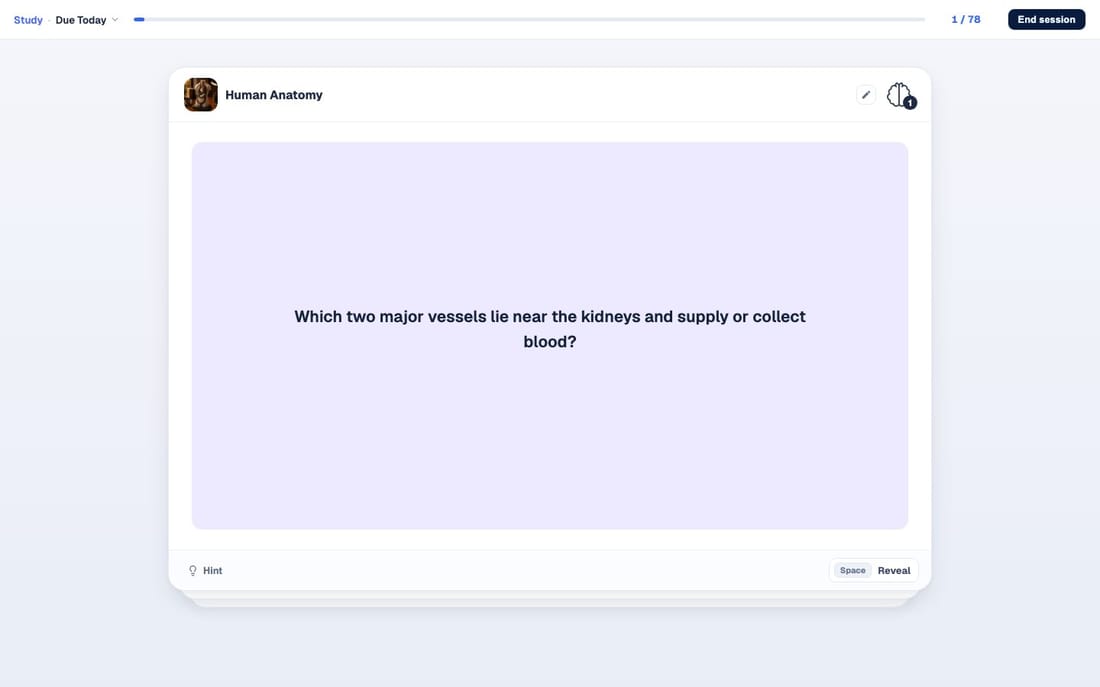
On paid plans, BrightStudy schedules every flashcard with an FSRS-based spaced repetition engine. After you reveal an answer you rate how well you remembered it: a confident answer pushes the next review further away, a miss brings the card back soon. Each day you get a Due queue across all your subjects, so you always know what to review.
Multiple-choice questions are scheduled the same way. When you answer a question correctly twice in a row, BrightStudy writes a fresh version of it testing the same idea in a different way, so you learn the concept rather than memorising one familiar question.
More ways BrightStudy helps with GCSE revision
Vault
Every file, image and recording you upload, organised into folders by subject. Deleted items stay recoverable for 30 days.
Progress tracking
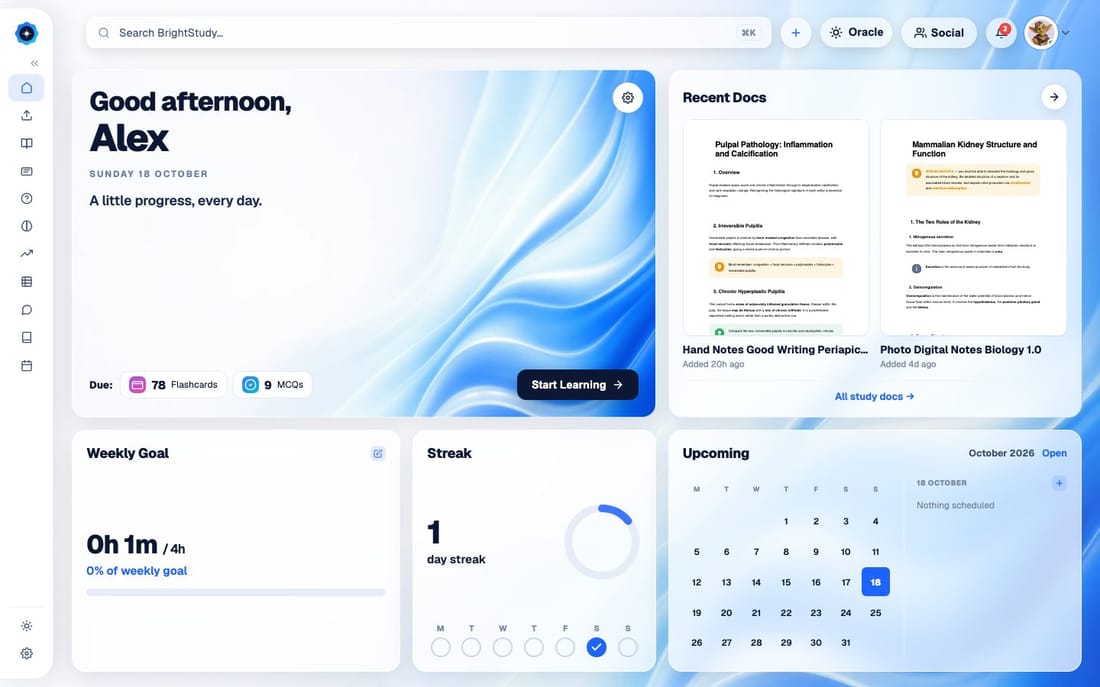
On paid plans, see topic strength from your flashcard and question results, accuracy trends over time, streaks and a weekly goal.
Calendar
Add exam dates, coursework deadlines and study sessions so you can see the run-up to exam season at a glance.
Oracle, the AI tutor
On paid plans, ask Oracle to explain a topic again, quiz you, or help you understand a document you have uploaded.
Community Library
Study Docs, flashcards and MCQs shared by BrightStudy and other students. Every resource is reviewed and approved by an admin before it is published.
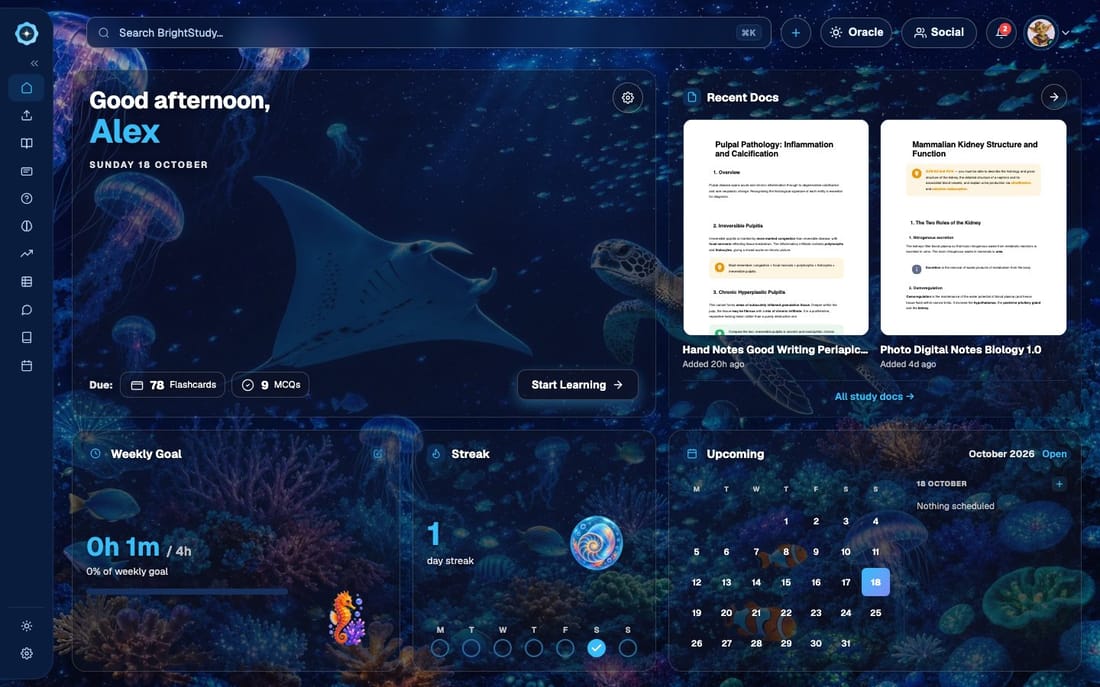
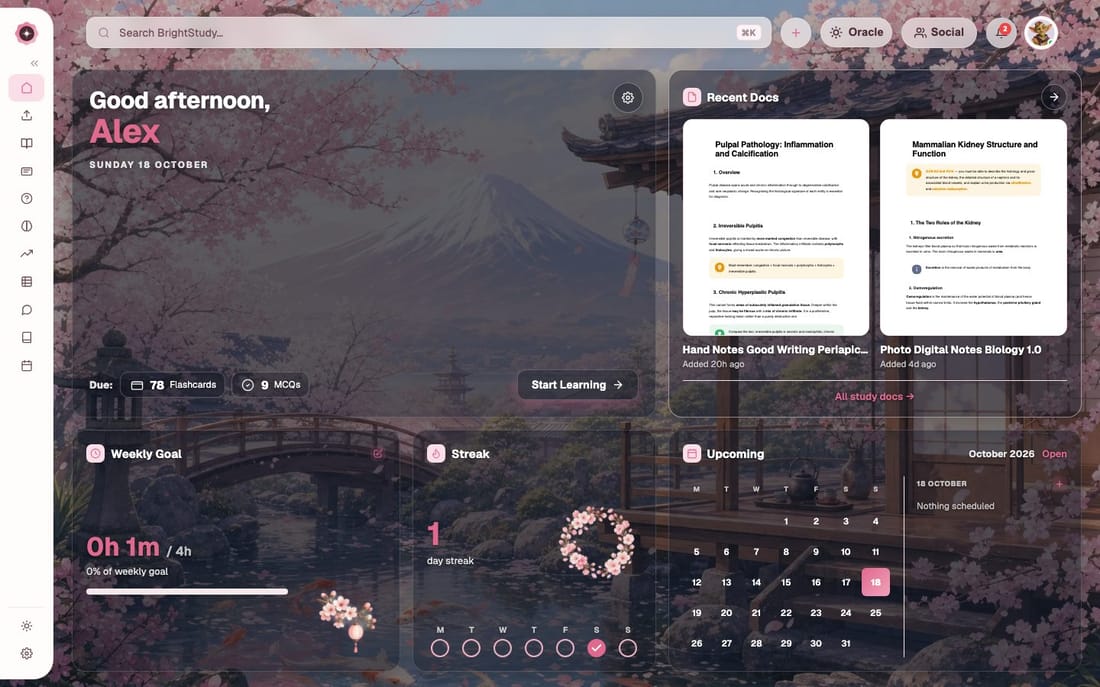
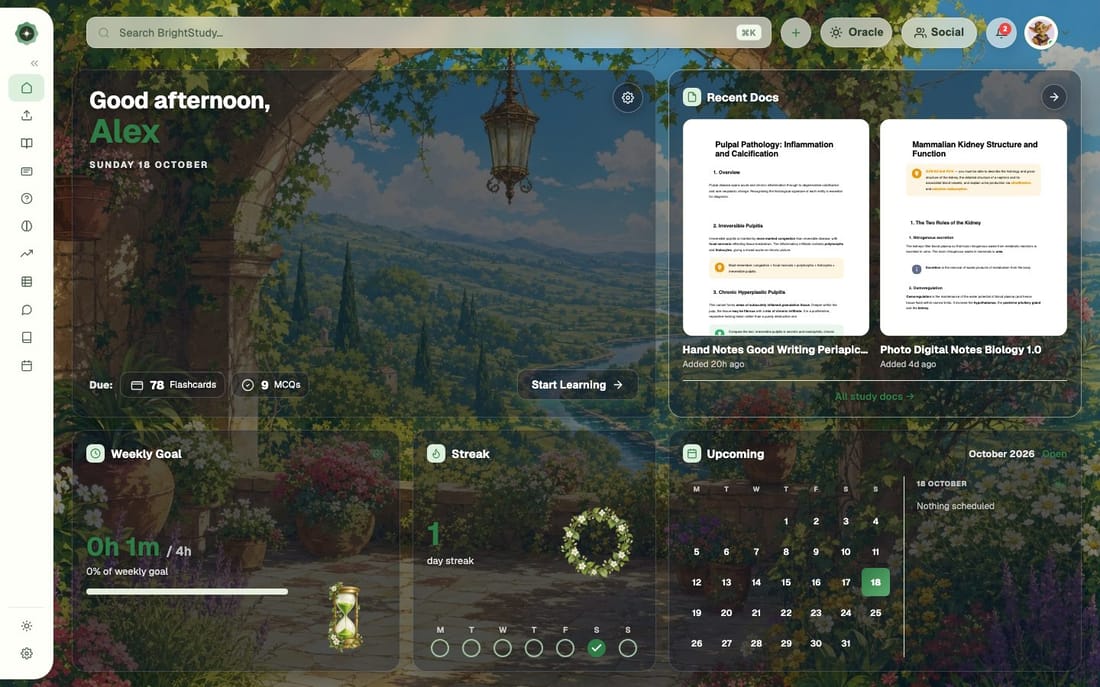
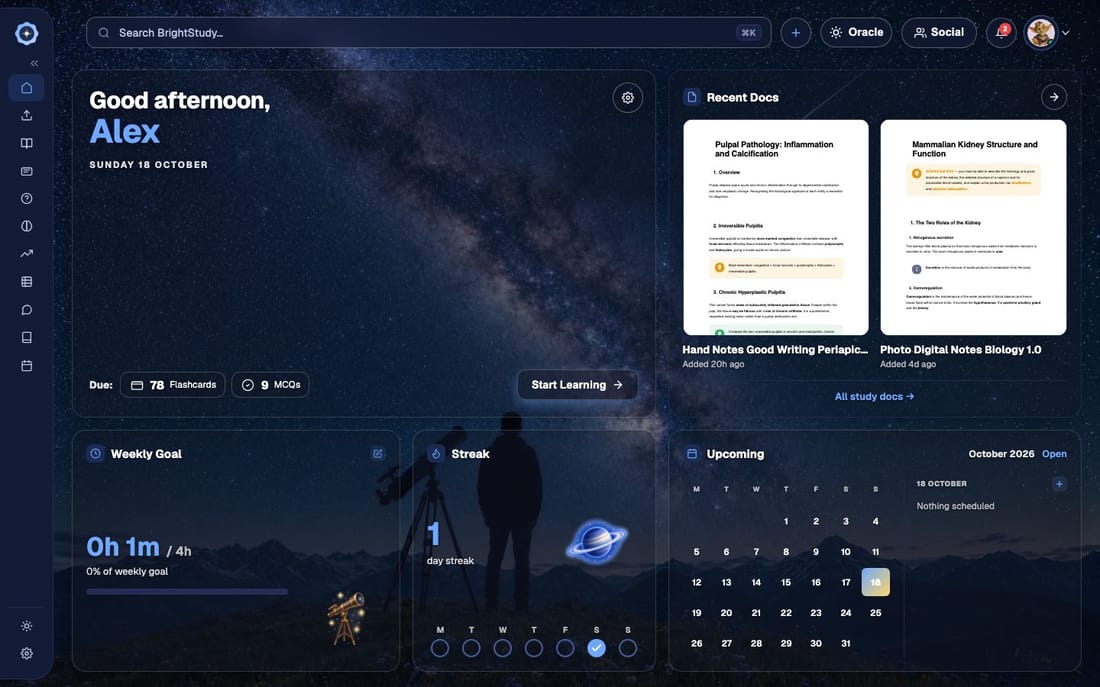
Twelve themes
Make your study space your own, from light themes for daytime revision to dark themes for evening sessions.
Choose a study space you actually want to open
Your theme changes the whole of BrightStudy, from the dashboard to every page. Swipe through a few of the twelve themes.
Common GCSE revision mistakes
Rereading and highlighting
They feel productive but build familiarity, not memory. Replace most rereading with questions and flashcards.
Making beautiful notes and stopping there
Notes are a starting point. The learning happens when you test yourself on them, repeatedly, over weeks.
Revising only favourite subjects
It is natural to gravitate to what you enjoy. Your timetable should give the most time to the subjects and topics you find hardest.
Leaving past papers until May
Exam technique takes practice. Start timed questions after your first mocks so there is time to act on what they show.
Ignoring the specification
Without it you cannot be sure you have covered everything, or that you are not revising content your board does not include.
All-nighters before an exam
Sleep is when memories are consolidated. A rested brain retrieves far more in the exam hall than a tired one.
How parents can support GCSE revision
You do not need to know the content to help. The most useful support is practical: a quiet place to work, a realistic timetable agreed together, and gentle check-ins about what was covered rather than how many hours were spent.
Ask your teenager to explain a topic to you, or to show you the flashcards they reviewed today. Talking it through is excellent retrieval practice, and it shows you whether revision is active or passive.
Keep an eye on balance. Exercise, time with friends and regular sleep all support learning, and short breaks between sessions make revision more effective, not less.
GCSE revision: frequently asked questions
When should I start revising for my GCSEs?
Light, regular review from the start of Year 10 makes Year 11 far easier. Most students step up to a structured revision timetable after their Year 11 mocks, giving several months of focused preparation before the summer exams.
How many hours a day should I revise for GCSEs?
Quality matters more than hours. Two or three focused sessions of 30 to 45 minutes on school days, built around self-testing, is a strong routine. In the holidays and the final weeks, many students do more, but always with breaks.
What is the best way to revise for GCSEs?
Active recall and spaced repetition: test yourself with flashcards and exam questions instead of rereading, and come back to each topic at increasing intervals. Add timed past-paper practice from Year 11.
What grade is a pass at GCSE?
In England, grade 4 is a standard pass and grade 5 is a strong pass. Many sixth forms and colleges ask for grade 4 or above in English and maths, and higher grades in subjects you want to continue at A level.
How do I find out which exam board I am studying?
Ask your teacher or check your school’s website; boards are chosen subject by subject. The specification code is often printed on your exam timetable and on past papers your teacher gives you.
What is the difference between combined and triple science?
Combined Science is worth two GCSEs and covers biology, chemistry and physics with a double grade such as 6–6. Triple science means three separate GCSEs in Biology, Chemistry and Physics, with more content in each.
What happens if I do not get a grade 4 in English or maths?
In England you will continue studying the subject after Year 11, usually resitting the GCSE at sixth form or college until you reach grade 4, or taking Functional Skills in some cases.
Are GCSE mocks important?
Mocks do not count towards your final grade, but they are often used to decide tiers and predicted grades, and they are the best data you have about what to revise next.
Can BrightStudy make flashcards from my class notes?
Yes. Upload notes, PDFs, slides, Word documents or photos of handwritten pages, and BrightStudy can create a Study Doc, flashcards and exam-style questions from them. AI generation uses an allowance on the free plan and is fully available on paid plans.
Is BrightStudy free for GCSE students?
You can join for free and create unlimited flashcards, MCQs and Study Docs by hand, study your own materials and try the AI tools within an allowance. Paid plans add spaced repetition scheduling, progress analytics, AI creation and the Oracle tutor. See pricing for details.
Does BrightStudy work on my phone?
BrightStudy runs in any modern web browser on phones, tablets and computers. Dedicated iPhone and Android apps are coming soon.
How do I stay motivated during GCSE revision?
Break big goals into daily ones, track what you have completed, and reward consistency rather than long hours. Seeing your topic strength improve week by week is a powerful motivator.
Other stages of UK study
Start your GCSE revision today
Upload your notes, make your first flashcards and build a routine that lasts until the final exam.