Every stage of UK education, explained
How the UK education system fits together, what each stage involves and how it is assessed, and the revision methods that work from primary school to a master’s degree.
How the UK education system fits together
Education in the UK is organised separately in each nation: England, Wales, Scotland and Northern Ireland each have their own curriculum, qualifications and inspection systems. They share a broad structure, though: primary school, secondary school, then a range of routes through further education, apprenticeships, university and lifelong learning.
In England, children start school in Reception at four or five. Primary school covers Key Stages 1 and 2 (ages 5 to 11), and secondary school covers Key Stages 3 and 4 (ages 11 to 16), ending with GCSEs. Young people must then stay in education or training until 18, through A levels, T Levels, vocational qualifications such as BTECs, or an apprenticeship. After that, many go on to an undergraduate degree, and some to postgraduate study.
Learning does not stop there. Millions of adults study every year for professional qualifications, career changes and personal interest, in colleges, universities, workplaces and online.
Explore each stage of UK study
Each guide explains how that stage works, how it is assessed, every subject on our UK curriculum map and the revision methods that suit it.
KS1 and KS2: a guide to primary learning and SATs
Key Stages 1 and 2 · Years 1 to 6 · ages 5–11

GCSE revision: the complete guide
GCSE · Years 10 and 11 · ages 14–16

A level revision: the complete guide
A level and AS level · Years 12 and 13 · ages 16–18

BTEC, T Level and apprenticeship study guide
Further education, vocational and technical

University study and degree revision: the complete guide
Undergraduate degrees
Master’s and postgraduate study: the complete guide
Master’s and postgraduate study

Adult learning in the UK: a complete study guide
Adult, professional and online learning
UK stages of education compared
A summary of the main stages in England. Wales, Scotland and Northern Ireland differ in places, described below.
| Stage | Typical ages | Main qualifications | How it is assessed |
|---|---|---|---|
| Primary (KS1–KS2) | 5–11 | None (national checks and Year 6 SATs) | Phonics check, multiplication check, KS2 SATs, teacher assessment |
| Secondary (KS3–KS4) | 11–16 | GCSEs, graded 9–1 | Mostly exams at the end of Year 11, some coursework |
| Sixth form | 16–18 | A levels, graded A*–E | Exams at the end of Year 13, some coursework |
| Further education | 16+ | T Levels, BTECs, NVQs, apprenticeships, Functional Skills | Assignments, practical assessment, exams, end-point assessment |
| Undergraduate | 18+ | Bachelor’s degree with honours | Exams, coursework, dissertation; classified 1st to 3rd |
| Postgraduate | 21+ | Master’s, PGCert, PGDip, doctorate | Coursework, exams, dissertation; Distinction, Merit, Pass |
| Adult learning | Any | Professional and Level 2–7 qualifications | Varies by course and awarding body |
Qualification levels explained
In England, Wales and Northern Ireland, qualifications are placed on levels so they can be compared. The Regulated Qualifications Framework (RQF) covers most qualifications outside universities, and the Framework for Higher Education Qualifications (FHEQ) covers degrees.
- Entry Level and Level 1: foundation skills, such as GCSE grades 3 to 1 and Functional Skills Level 1.
- Level 2: GCSE grades 9 to 4, intermediate apprenticeships and Functional Skills Level 2.
- Level 3: A levels, T Levels, BTEC Nationals, advanced apprenticeships and the Access to HE Diploma.
- Levels 4 and 5: the first and second years of a degree, HNCs, HNDs and foundation degrees.
- Level 6: a bachelor’s degree with honours and degree apprenticeships.
- Level 7: master’s degrees, PGCerts, PGDips and some professional qualifications.
- Level 8: doctorates such as the PhD.
Education in England, Wales, Scotland and Northern Ireland
England
The National Curriculum, GCSEs graded 9 to 1, A levels, T Levels and BTECs. Exam boards include AQA, OCR, Pearson Edexcel and WJEC Eduqas.
Wales
The Curriculum for Wales, WJEC GCSEs graded A* to G, A levels in which AS results still count, and the Welsh Baccalaureate.
Scotland
The Curriculum for Excellence, with National 4 and 5, Highers and Advanced Highers set by the SQA, and four-year honours degrees.
Northern Ireland
Its own curriculum and key stages, with GCSEs and A levels mainly from CCEA, which grades GCSEs from A* to G including a C* grade.
Key Stage 3: the first years of secondary school
Key Stage 3 covers Years 7 to 9 (ages 11 to 14). Students follow the National Curriculum across a broad range of subjects, including English, maths, science, history, geography, a modern foreign language, computing, design and technology, art, music and PE, before choosing their GCSE options, usually in Year 9.
There are no national exams at KS3, but it is the best time to build study habits that make GCSEs manageable: reviewing lessons regularly, using flashcards for key facts and vocabulary, and practising explaining ideas in writing.
A levels, T Levels, BTECs or an apprenticeship?
At 16, students in England choose how to continue their education or training until 18. Each route suits different goals and ways of learning.
| Route | Best for | How you learn | Where it leads |
|---|---|---|---|
| A levels | Students who enjoy academic study and exams | Classroom study of three subjects, mostly assessed by exams | University, degree apprenticeships, work |
| T Levels | Students who know the industry they want to work in | Classroom and practical learning plus a 45-day industry placement | Skilled work, apprenticeships, university |
| BTEC Nationals | Students who prefer applied, coursework-based learning | Units assessed by assignments and some exams | University, apprenticeships, work |
| Apprenticeships | Students who want to earn while they learn | A paid job with off-the-job training and an end-point assessment | Skilled employment, higher and degree apprenticeships |
Read our guide to BTECs, T Levels and apprenticeships for a detailed comparison.
UK exam boards explained
GCSEs and A levels are set and marked by exam boards, also called awarding bodies. In England the main boards are AQA, OCR, Pearson Edexcel and WJEC Eduqas; in Wales, WJEC; in Northern Ireland, CCEA; and in Scotland, the SQA sets National qualifications and Highers. Vocational qualifications come from awarding organisations such as Pearson, City & Guilds and NCFE.
Each board publishes a specification for every qualification: the official list of what can be assessed and how. Schools and colleges choose boards subject by subject, so it is worth checking which specification you are studying for each subject. Revising from it is the surest way to cover everything that can come up.
How study skills develop through the stages
Primary
Short, frequent practice of core facts, reading every day, and lots of encouragement. Adults guide the learning.
Key Stage 3
Building independence: homework routines, simple flashcards, and learning to review lessons without being asked.
GCSE
Structured revision across many subjects, retrieval practice, spaced review and exam technique.
A level and college
Deeper study of fewer subjects, wider reading, independent research and sustained revision over two years.
University
Managing large volumes of content, critical thinking, academic writing and self-directed learning.
Adult and postgraduate
Fitting focused study around work and life, applying learning to experience, and keeping knowledge fresh with short daily reviews.
The revision methods that work from primary school to a master’s
Research on learning has identified a small number of techniques that work across ages and subjects. They are simple to describe and take discipline to use, but they consistently beat rereading and highlighting.
Active recall
Test yourself instead of rereading: flashcards, practice questions, or writing down everything you remember about a topic before checking your notes. The effort of retrieving information is what strengthens memory.
Spaced repetition
Review material at increasing intervals, after a day, a few days, a week, a month. Spacing protects against forgetting far better than cramming the same material in one session.
Interleaving
Mix topics and question types within a session, so you practise choosing the right approach, which is exactly what exams demand.
Elaboration and explanation
Explain ideas in your own words, connect them to what you already know and ask why and how. If you can teach it, you understand it.
Worked examples and practice
Study a worked solution, then solve similar problems yourself, gradually removing the support. This is especially powerful in maths and science.
Practice under real conditions
Timed questions in the format of the real assessment build exam technique and show you what you can actually do.
Plan, then review
A realistic timetable built around your weakest topics, reviewed weekly, keeps revision on track without burning out.
Sleep and breaks
Memories are consolidated during sleep, and attention fades in long sessions. Rest is part of learning, not time away from it.
One learning system for every stage
BrightStudy turns what you study into organised, active learning. Upload slides, PDFs, Word documents, photos of handwritten notes, audio recordings or YouTube lectures, and each becomes a structured Study Doc in your Vault, with flashcards and exam-style questions generated from the same material and checked by a separate AI reviewer.
On paid plans, an FSRS-based spaced repetition engine schedules every card and question, progress analytics show topic strength over time, and Oracle, the AI tutor, explains anything you are stuck on. The Community Library adds reviewed Study Docs, flashcards and questions from BrightStudy and other students.
What you can do with BrightStudy
Upload and transform
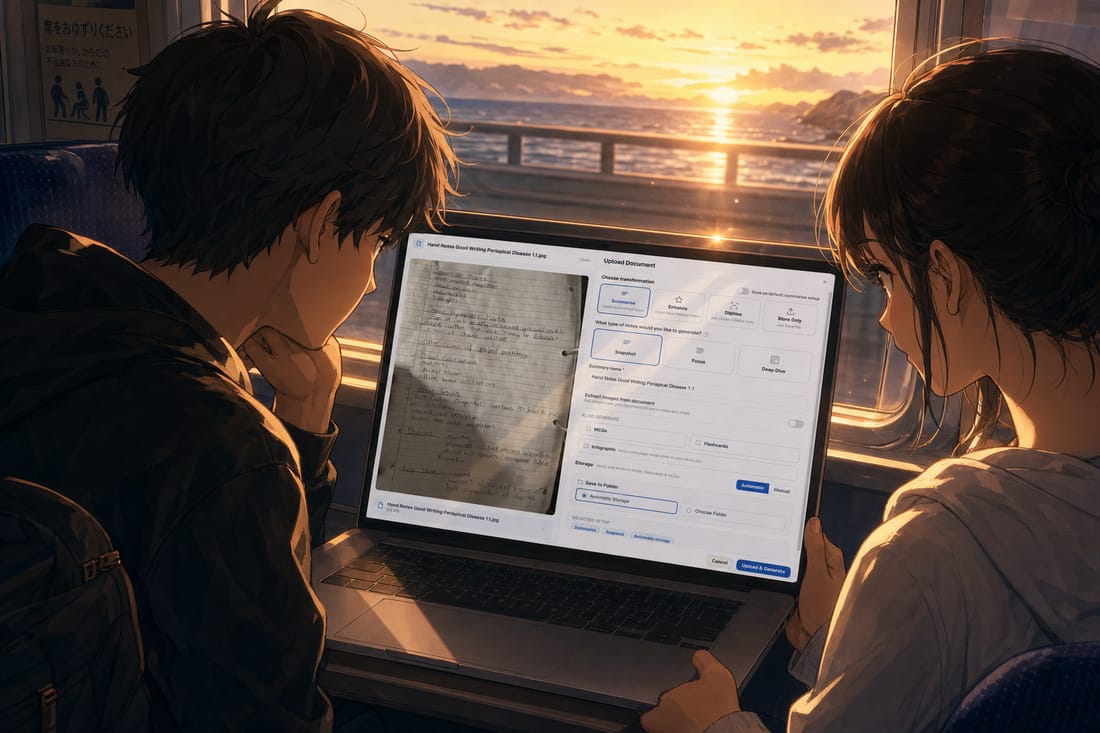
Choose to summarise, enhance or digitise each upload, with Snapshot or Focus notes (Deep Dive notes on the Pro plan), and optionally generate MCQs, flashcards and an infographic at the same time.
Flashcards and spaced repetition
Make unlimited flashcards by hand on the free plan, or generate them from your uploads; paid plans schedule them with an FSRS-based engine.
Exam-aligned questions
Questions shaped by your study profile, with explanations for every option, and fresh versions once you answer correctly twice in a row.
Deep Recall
Explain a topic in your own words and see how your explanation measures up against the key points.
Vault and Calendar
Every file organised in folders, with extracted images, plus a calendar for exams, deadlines and study sessions.
Community Library
Reviewed study resources, each approved by an admin before publishing, organised by subject, course and topic.
From upload to revision in minutes
Drop in a lecture slide deck or a photo of your handwritten notes and choose what you want back. BrightStudy reads the document, creates your Study Doc and, if you ask, writes flashcards and multiple-choice questions from it, all stored together so you can jump between them.
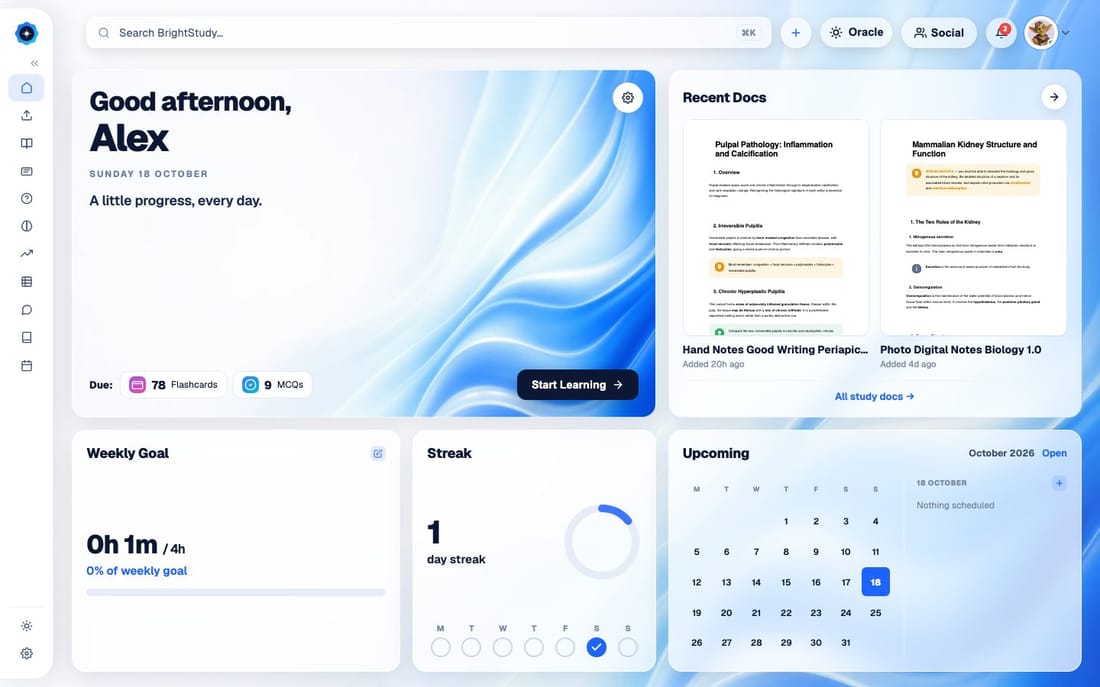
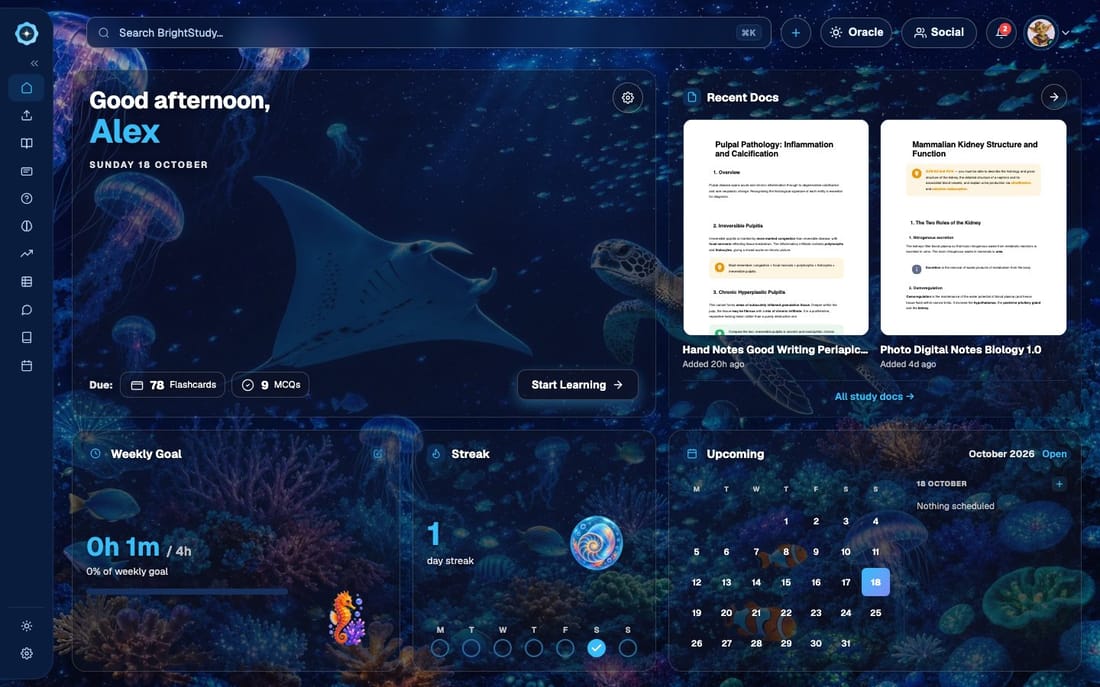
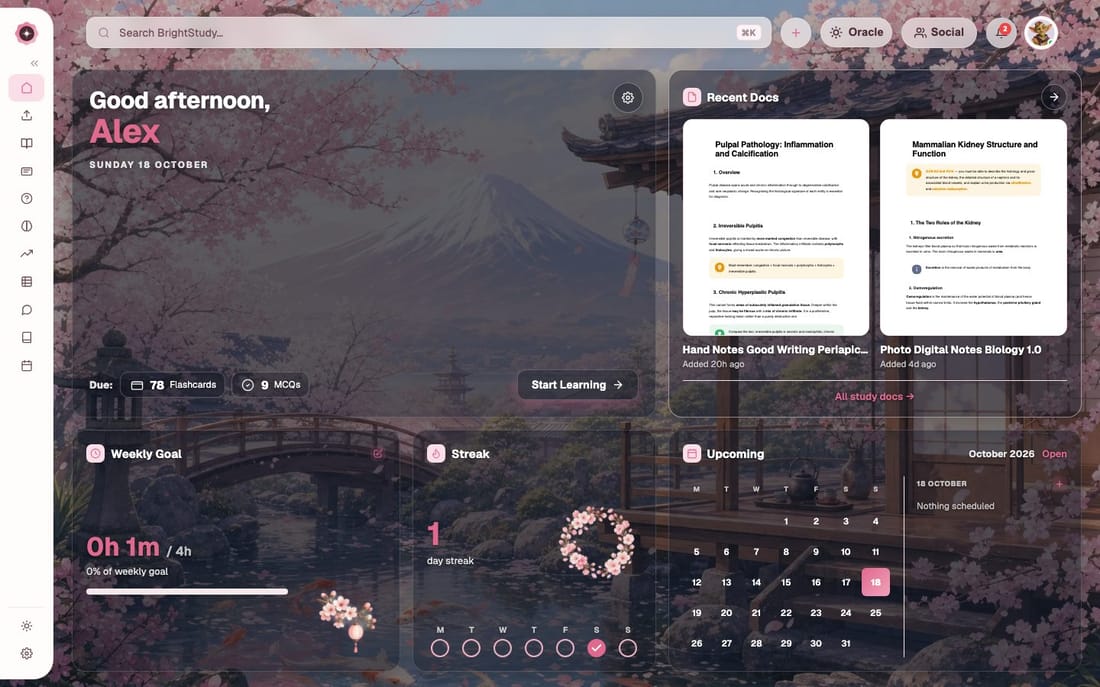
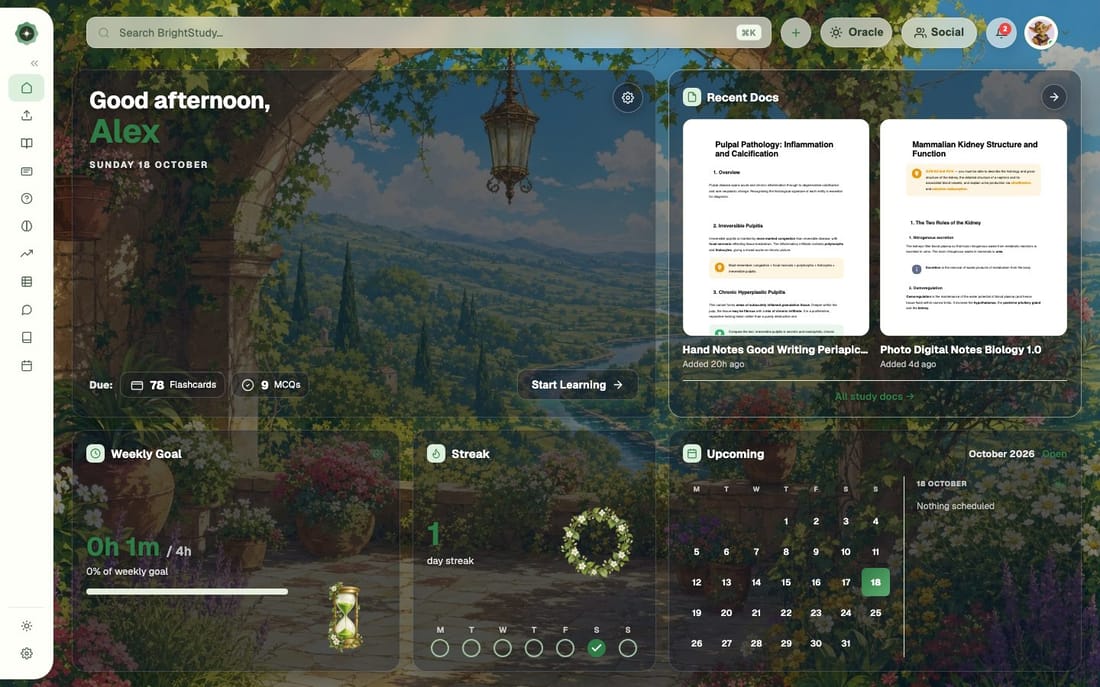
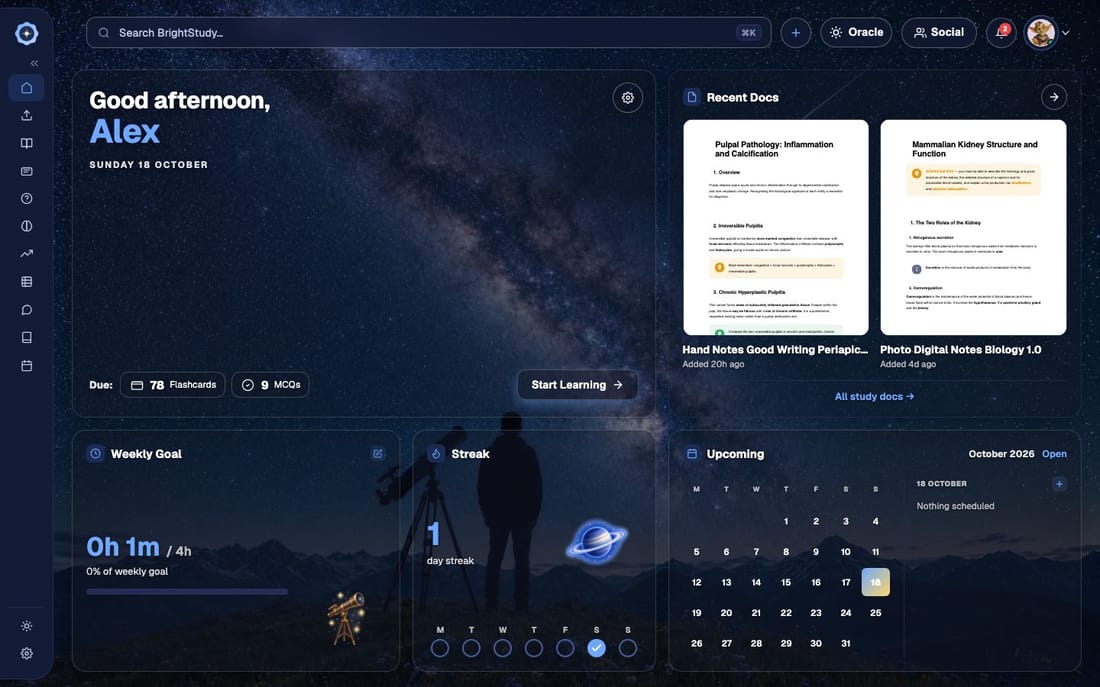
Your daily dashboard then shows what is due, your weekly goal, your streak and what is coming up in your calendar, so every session starts with the right thing.
Twelve themes, one learning system
Your theme changes the whole of BrightStudy. Here are a few of them.
A quick guide for parents and carers
However old your child is, the most valuable support is the same: a calm place to study, a realistic routine and interest in what they are learning. You do not need to know the content; asking your child to explain a topic to you is one of the best revision activities there is.
Each stage has its own pressure points: SATs in Year 6, options in Year 9, GCSEs in Year 11, decisions at 16 and university applications in Year 13. Our guides to each stage explain what is involved, so you know what to expect and when.
Above all, encourage consistency over intensity. Little and often, with rest and sleep protected, beats long, stressful sessions at every age.
Five revision myths, and what works instead
Myth: rereading notes is revision
Rereading builds familiarity, which feels like knowing. Testing yourself builds memory you can actually use in an exam.
Myth: highlighting helps you remember
Highlighting on its own does little. Turning key points into questions you answer later is far more effective.
Myth: cramming works if you are disciplined
Cramming can carry you through the next morning, but most of it is forgotten within days. Spacing reviews out keeps knowledge for the long term.
Myth: you have a fixed learning style
There is little evidence that matching teaching to a visual, auditory or kinaesthetic “style” improves learning. Methods such as retrieval and spacing help everyone.
Myth: more hours always means better results
Focused, active sessions with breaks and good sleep beat long, tired ones. Quality of practice matters more than time spent.
Why active recall and spacing work
Memory researchers have studied how people learn for more than a century, and two findings are among the most reliable in all of psychology. The first is the testing effect: retrieving information from memory strengthens it far more than reviewing it again. When you answer a flashcard or an exam question, the effort of recalling the answer makes it easier to recall next time. Rereading, by contrast, mostly makes material feel familiar, which is easily mistaken for knowing it.
The second is the spacing effect: reviews spread out over time produce much stronger long-term memory than the same amount of study packed into one session. Each time you return to something just as it is starting to fade, the memory becomes more durable, and the gap before you need to review it again grows. Spaced repetition systems use this pattern to schedule reviews automatically, so the material you find hardest comes back most often.
Together, these effects explain why short daily sessions of self-testing beat long nights of rereading at every stage of education, from a Year 4 child learning times tables to a postgraduate student preparing for exams. They also explain why the techniques feel harder: effortful retrieval is less comfortable than passive review, but that effort is exactly what produces learning.
How we researched the UK curriculum
The subject lists on these pages come from our research into the official documents that define UK study: the Department for Education’s National Curriculum and GCSE and A level subject content, the current specifications from AQA, OCR, Pearson Edexcel and WJEC Eduqas, vocational specifications and occupational standards from Pearson, City & Guilds, NCFE and Skills England, QAA subject benchmark statements, professional and regulatory standards, and published university module descriptors.
Every learning point in our research keeps a quote from the source it came from, so the map reflects what is actually taught and assessed rather than guesswork.
UK education and revision: frequently asked questions
What are the key stages in UK education?
In England, Key Stage 1 covers Years 1 and 2 (ages 5 to 7), Key Stage 2 Years 3 to 6 (ages 7 to 11), Key Stage 3 Years 7 to 9 (ages 11 to 14) and Key Stage 4 Years 10 and 11 (ages 14 to 16), ending with GCSEs.
What comes after GCSEs?
In England, young people stay in education or training until 18. The main routes are A levels, T Levels, vocational qualifications such as BTECs, and apprenticeships.
What is the best way to revise?
Active recall and spaced repetition: test yourself instead of rereading, and review material at increasing intervals. Add timed practice in the format of your real assessment.
How do the UK nations differ?
England, Wales, Scotland and Northern Ireland each run their own education systems. Scotland has National 5s, Highers and four-year degrees; Wales and Northern Ireland have their own curricula and GCSE grading; England uses 9 to 1 GCSE grades.
What are qualification levels?
A way of comparing qualifications. In England, GCSEs at grades 9 to 4 are Level 2, A levels and T Levels are Level 3, a bachelor’s degree is Level 6, a master’s is Level 7 and a doctorate Level 8.
What is the difference between GCSEs and A levels?
GCSEs are taken by most students at 16 across eight to ten subjects and are graded 9 to 1 in England. A levels are two-year courses in usually three subjects, taken from 16 to 18 and graded A* to E, and are the main route to university.
Are T Levels and BTECs accepted by universities?
Many universities accept T Levels and BTEC Nationals, which carry UCAS tariff points, for a wide range of courses. Requirements vary by course, so check each university’s entry requirements.
What is the difference between a bachelor’s and a master’s degree?
A bachelor’s degree is an undergraduate qualification at Level 6, usually three years in England. A master’s is a postgraduate qualification at Level 7, usually one year full-time, with more advanced and independent study.
What are exam boards?
Organisations that set and mark qualifications. AQA, OCR, Pearson Edexcel and WJEC Eduqas are the main GCSE and A level boards in England; WJEC serves Wales, CCEA Northern Ireland and the SQA Scotland.
How do I revise effectively for any exam?
Find the specification or learning outcomes, test yourself with questions and flashcards instead of rereading, review material on a spaced schedule, and finish with timed practice in the format of the real assessment.
Who is BrightStudy for?
BrightStudy is built for independent learners from secondary school upwards, including GCSE and A level students, college and university students, postgraduates and adult learners. Parents and teachers can also use it to make flashcards for younger children.
Is BrightStudy free?
Yes, you can join for free and create unlimited flashcards, MCQs and Study Docs by hand, study your own materials and try the AI tools within an allowance. Paid plans add spaced repetition, analytics, AI creation and the Oracle tutor; see pricing.
Does BrightStudy have a mobile app?
BrightStudy works in any modern browser on phones, tablets and computers today. Dedicated iPhone and Android apps are coming soon.
How long should a revision session be?
Most people concentrate best in focused blocks of 25 to 45 minutes with a short break between them. Younger children benefit from even shorter sessions of 10 to 15 minutes.
Does BrightStudy follow the UK curriculum?
BrightStudy builds study material from what you upload, such as class notes, slides and specifications, so it follows whatever course you are studying. The subject guides on these pages are based on our research into the official UK curriculum documents.
Other stages of UK study
Learn. Organise. Discover. Improve.
Whatever stage you are at, start building study habits that last.