A level revision: the complete guide
Everything you need to plan two years of A level study: how the qualification works, what universities look for, every subject and exam board, and the revision methods behind A* grades.
How A levels work
A levels (Advanced Levels) are two-year courses taken in Year 12 and Year 13, usually at a school sixth form, a sixth form college or a further education college. They are the most common route to university in England, Wales and Northern Ireland, and most students take three subjects, sometimes four.
Since the reforms that began in 2015, A levels in England are linear. All of the exams are sat at the end of Year 13, in May and June, and they cover the full two years of content. Many papers include synoptic questions that ask you to connect ideas from across the whole course, which is why steady revision from the start of Year 12 pays off.
Compared with GCSE, A levels go much deeper into fewer subjects. You are expected to read more widely, work more independently and show higher-level skills: analysis and evaluation in essay subjects, and multi-step problem solving in maths and the sciences.

A level grades and UCAS tariff points
A levels are graded A* to E, with U for ungraded. Universities make offers either in grades (for example AAB) or in UCAS tariff points, and each grade carries a fixed number of points.
| A level grade | UCAS tariff points | AS level grade | UCAS tariff points |
|---|---|---|---|
| A* | 56 | — | — |
| A | 48 | A | 20 |
| B | 40 | B | 16 |
| C | 32 | C | 12 |
| D | 24 | D | 10 |
| E | 16 | E | 6 |
The Extended Project Qualification (EPQ) is worth half an A level in UCAS points, up to 28 for an A*. Some universities make lower offers to applicants who complete one, because it shows independent research skills.
In England, the AS level is now a separate, standalone qualification. AS results no longer count towards the final A level grade, so most students in England sit only the full A level exams at the end of Year 13. In Wales, AS levels still count towards the full WJEC A level.
Practical endorsement, coursework and the EPQ
In biology, chemistry and physics, A level students complete a set of practical activities over the two years. Teachers assess practical skills against common criteria, and the result is reported as a separate practical endorsement, Pass or Not Classified, alongside your grade. Practical knowledge is also examined directly in the written papers, so treat your lab work as revision material.
Several subjects include non-exam assessment (NEA): a coursework essay in English literature and history, an independent investigation in geography, a programming project in computer science, and practical work in art, design and technology, music and drama. NEA usually counts for around 20 per cent of the grade, so getting it finished early in Year 13 frees up time for exam revision.
The EPQ is a single piece of independent work, either a 5,000-word dissertation or an artefact or performance with a written report, on a topic you choose. It develops the research, referencing and project-management skills you will need at university.
The jump from GCSE to A level: what changes
Almost every student finds the first term of Year 12 a step up. Knowing what is different helps you adapt quickly instead of discovering it at your first assessment.
Depth over breadth
You study three or four subjects instead of eight or more, but each goes much deeper. Expect to understand mechanisms, theories and arguments, not just facts.
More independent study
Timetables include free periods, and teachers expect you to use them. A useful rule of thumb is to match each hour of lessons with roughly an hour of your own work.
Higher-level skills
Analysis and evaluation carry more of the marks. A correct but descriptive answer rarely reaches the top bands.
Content that builds
Later topics depend on earlier ones, and linear exams test everything. Gaps from the autumn of Year 12 cause problems in Year 13.
Wider reading
Textbooks are a minimum. Articles, case studies and current examples are what make strong answers stand out.
Time management
Coursework, the EPQ, part-time jobs and UCAS applications all compete for time. A weekly plan stops any one of them crowding out revision.
Every A level subject, grouped by area
Here is every A level subject on our UK curriculum map, grouped by area. Each was researched from the Department for Education’s AS and A level subject content and the current specifications from the exam boards. Some subjects, especially community languages, are offered by only one board, such as Pearson Edexcel for Italian and Russian or AQA for Bengali, Modern Hebrew and Polish.
Sciences 5 subjects · AQA, Department for Education, OCR, WJEC Eduqas, Pearson Edexcel
Maths and statistics 3 subjects · AQA, Department for Education, OCR, Pearson Edexcel
English and languages 25 subjects · Department for Education, Pearson Edexcel, AQA, OCR, WJEC
Humanities and social sciences 10 subjects · Department for Education, OCR, WJEC, AQA, Pearson Edexcel, WJEC Eduqas
Business, law and economics 4 subjects · Department for Education, AQA, OCR
Computing, engineering and technology 3 subjects · AQA, Department for Education, OCR, Pearson Edexcel
Medicine, health and care 2 subjects · WJEC, Department for Education, AQA, OCR
Arts, media and performance 6 subjects · Department for Education, AQA, OCR, WJEC Eduqas
More subjects 1 subject · AQA, OCR
A level subjects universities often ask for
Requirements vary between universities and change over time, so always check the course pages for the exact offer. These are typical patterns for popular degrees.
| Degree | Usually required | Often useful |
|---|---|---|
| Medicine and dentistry | Chemistry, usually with biology | A third science or maths |
| Engineering | Maths, often physics | Further maths, chemistry or design and technology |
| Physics and astronomy | Maths and physics | Further maths |
| Economics | Often maths | Further maths, a humanities subject |
| Computer science | Often maths | Further maths, computer science, physics |
| Veterinary science | Chemistry and biology | Maths or physics |
| Psychology | Often a science or maths for BSc courses | Biology, psychology |
| Law, history, English | Usually no fixed subjects | Essay subjects such as history or English literature |
If you are undecided, combinations that include maths, a science or an essay-based subject keep many doors open.
How to choose your A level subjects
Start with what you might want to do afterwards. Many university courses require particular A levels: medicine and dentistry usually need chemistry and often biology; engineering and physics degrees need maths and physics; economics degrees often want maths. Check the entry requirements of a few courses that interest you before you decide.
If you are not sure yet, choose subjects you enjoy and do well in, and keep options open with subjects that many degrees accept. Universities value strong grades in rigorous subjects, but enjoying a subject is one of the best predictors of doing well in it.
Think about the jump from GCSE too. A level maths, the sciences and modern languages build directly on GCSE content and assume grade 6 or above; subjects such as psychology, sociology, law and economics are usually new, so a strong essay-writing background helps.
How to revise for A levels: methods that lead to top grades
The jump in volume from GCSE to A level is large, and rereading two years of notes in a few months simply does not work. The students who get top grades revise continuously, test themselves constantly and practise applying what they know.
Consolidate every week from Year 12
After each topic, make concise notes and a set of flashcards, then review them on a spaced schedule. By the time Year 13 revision begins, most of the course is already familiar.
Learn the assessment objectives
Every specification lists assessment objectives, typically knowledge (AO1), application (AO2) and analysis or evaluation (AO3). Top-band answers show all of them. Read the mark schemes to see how marks are split.
Practise retrieval, not recognition
Close your notes and write down everything you know about a topic, then check what you missed. Flashcards and exam questions do the same job in smaller pieces.
Build synoptic links
Keep a running list of connections across topics, such as energy in biology, equilibrium across chemistry, or a theme across historical periods, and test yourself on them.
Plan essays as well as writing them
For essay subjects, a timed 10-minute plan for every likely question is an efficient way to cover a whole topic. Write full essays regularly too, and get them marked.
Do past papers under time pressure
From the spring of Year 13, complete full papers in exam conditions. Mark them against the mark scheme and turn every mistake into a flashcard or a practice question.
Read beyond the textbook
Wider reading, such as articles, case studies and current examples, gives your answers the depth and evaluation that separate an A from an A*.
Use interleaving in maths and the sciences
Mix question types in each session so you practise choosing the right method, not just executing it, exactly what unfamiliar exam questions test.
Revise your practical work
For each required practical, know the method, variables, sources of error, safety points and how to process the data. These questions are predictable marks.
Protect your energy
Two years is a long time. Regular sleep, exercise and genuine breaks keep you learning effectively all the way to the last exam.
A level revision tips for popular subjects
A level maths and further maths
Practise every type of question until the method is automatic, and keep an error log. Pure maths underpins the applied papers, so secure calculus, algebra and trigonometry first. Use the large data set in statistics as your board specifies, and practise mechanics problems with clear diagrams.
A level biology
The content is broad, so spaced flashcards are essential for processes and definitions. Pay special attention to precise terminology, because mark schemes reward exact wording, and practise data analysis and the maths skills, which make up a significant share of the marks.
A level chemistry
Organic mechanisms, equilibria and calculations need daily practice. Draw mechanisms from memory, practise multi-step calculations with units, and revise inorganic trends with flashcards. Required practicals appear across the papers.
A level physics
Learn the equations you must recall and practise rearranging and combining them in unfamiliar contexts. Many questions test understanding of the physics behind a calculation, so explain each step in words as you practise.
A level psychology and sociology
Learn studies and theories with their key findings and strengths and weaknesses, then practise applying them to scenarios and writing evaluation. Flashcards suit studies; timed extended answers build the evaluation skills examiners reward.
A level history and English literature
Combine detailed knowledge with argument. Build flashcards of evidence, dates, quotations and critical views, and practise planning and writing essays that sustain a clear line of argument. NEA coursework is a chance to bank marks before the exams.
A level economics and business
Learn the diagrams and draw them accurately from memory, keep a bank of real-world examples, and practise evaluation: the “it depends” reasoning that earns the top marks in longer questions.
A term-by-term A level study plan
Year 12, autumn
Set up your system from day one: a folder per subject, condensed notes after each topic and flashcards reviewed daily. Habits formed now carry you through two years.
Year 12, spring
Start regular exam-style questions on completed topics and get them marked. Begin wider reading in each subject.
Year 12, summer
Internal exams test the whole of Year 12. Revise for them seriously; they often inform predicted grades for UCAS. Start your NEA or EPQ planning.
Year 13, autumn
Keep Year 12 content alive with spaced reviews while new topics arrive. Draft and finish NEA, and submit UCAS applications.
Year 13, mocks
Sit mocks as if they were the real exams. Your results show exactly where to focus in the final months.
Year 13, spring and summer
Full revision timetable: weak topics first, a timed paper in each subject every week or two, and spaced reviews of everything else until the last exam in June.
A sample Year 13 revision timetable
With three subjects, you can give each one focused time several days a week. This example is for the spring term of Year 13, around lessons and study periods.
| Day | Free period / after school | Evening session | Daily review |
|---|---|---|---|
| Monday | Subject A: past-paper question | Subject B: essay plan | Due flashcards |
| Tuesday | Subject C: problem set | Subject A: new flashcards from weak topics | Due flashcards |
| Wednesday | Subject B: wider reading | Subject C: practical review | Due flashcards |
| Thursday | Subject A: synoptic links | Subject B: timed essay | Due flashcards |
| Friday | Subject C: mixed questions | Rest or EPQ / NEA | Due flashcards |
| Saturday | Full timed paper | Mark it and log mistakes | Light |
| Sunday | Rest | Plan the week | — |
Exam technique for long A level papers
A level papers are often two hours or longer, with a mix of short questions and extended answers worth 15 to 25 marks. Allocate time by marks, roughly a minute and a half per mark in many essay papers, and stick to it so the longest questions get the time they deserve.
Read command words carefully. Assess, evaluate and to what extent all require a judgement supported by evidence, while explain and describe do not. Plan extended answers before writing; a short plan keeps your argument focused and makes sure every paragraph earns marks.
In maths and the sciences, set out working clearly, include units and check that your answer makes sense. Method marks often survive an arithmetic slip, but only if the examiner can follow your reasoning.
Using free periods and wider reading well
Free periods are where top A level grades are made. Use them for active work: turning the day’s lessons into flashcards, attempting exam questions, or reading around a topic. Save passive tasks for when you are tired.
Wider reading does not have to be heavy. A good subject magazine, a quality newspaper’s science or economics pages, a well-chosen podcast or a university lecture on YouTube all build the context and examples that make evaluation convincing. Keep a short note of each useful source and the argument it supports.
Supporting a sixth former through A levels
A levels ask a lot of independence, and the best support is usually structural rather than hands-on: a quiet space, a shared calendar of deadlines and exams, and conversations about plans after Year 13.
Encourage steady weekly work rather than end-of-course cramming, and watch for overload when coursework, UCAS applications and part-time work coincide in the autumn of Year 13. Helping your child plan that term can make a real difference.
Turn two years of A level notes into a revision system
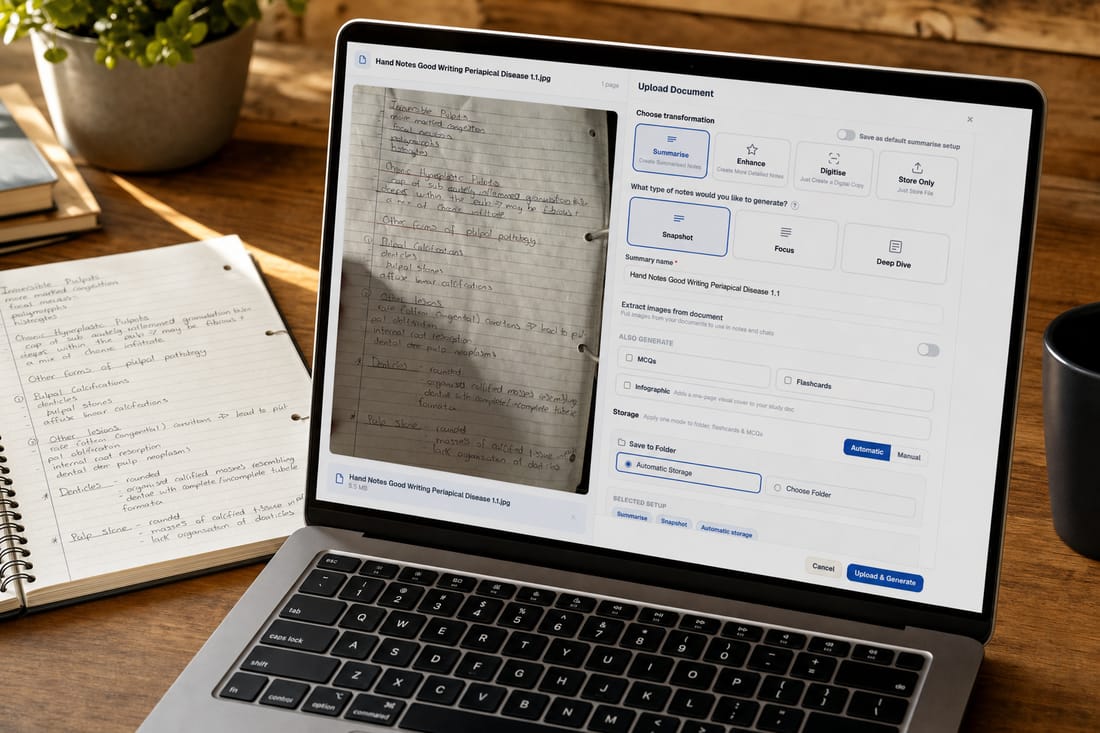
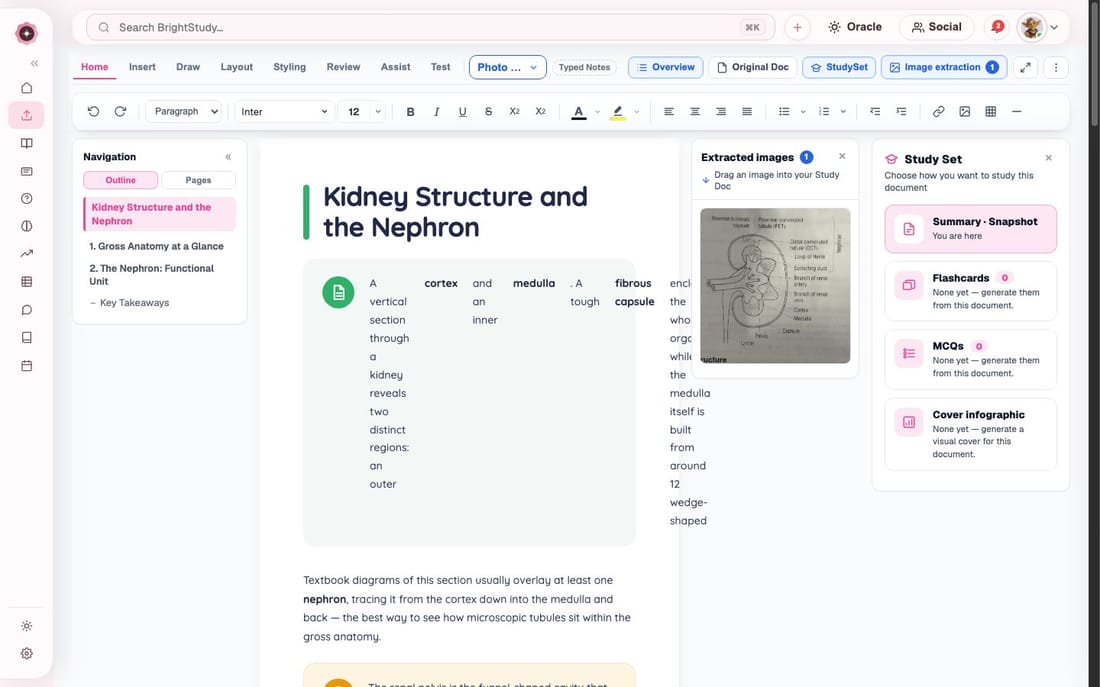
Upload your class notes, slides, PDFs, Word documents, photos of handwritten notes, audio recordings or YouTube lectures. BrightStudy turns each one into a structured Study Doc and can generate flashcards and exam-style questions from the same material, every question checked by a separate AI reviewer.
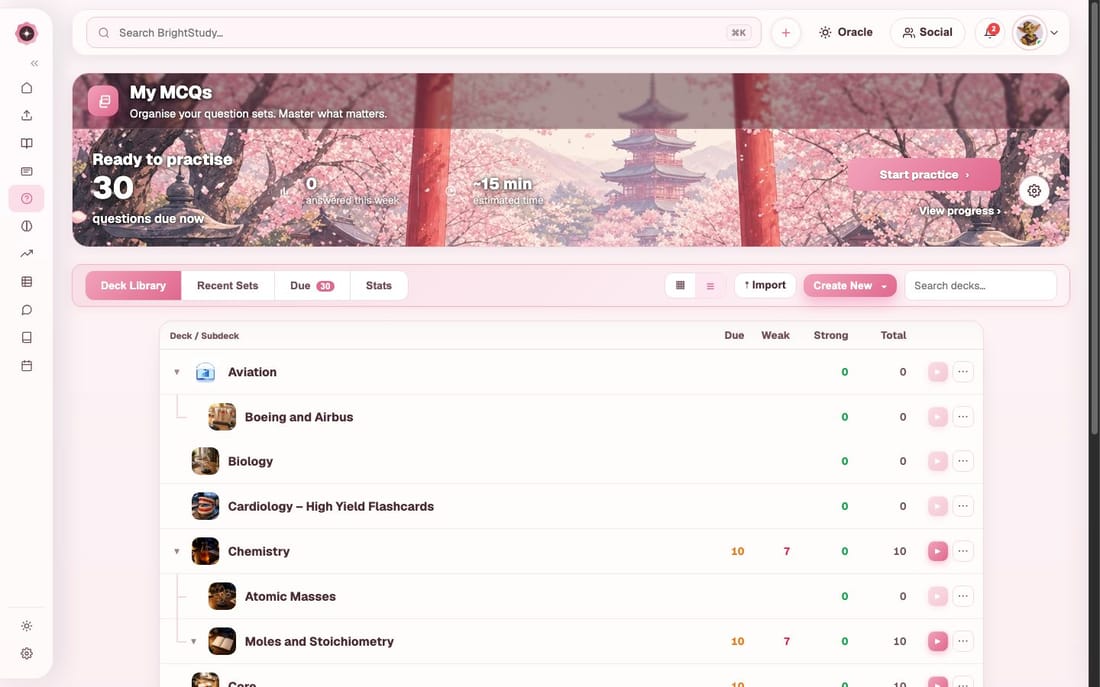
Questions are shaped by your study profile, so an A level student and a university student get questions at different depths on the same topic. Each answer comes with an explanation of why it is right and why the tempting options are wrong.
Keep Year 12 content fresh until your final exams
On paid plans, every flashcard is scheduled by an FSRS-based spaced repetition engine that adapts to how you actually remember. Rate each card after you reveal it and it returns just before you would forget it, which is how you keep Year 12 topics secure through to the summer of Year 13.
Multiple-choice questions use the same schedule. When you answer one correctly twice in a row, BrightStudy writes a new version testing the same idea differently, so you build real understanding rather than recognising a familiar question.
More BrightStudy tools for A level students
Deep Recall
Explain a topic in your own words and see how your answer compares with the key points, a fast way to find gaps in essay subjects.
Progress tracking
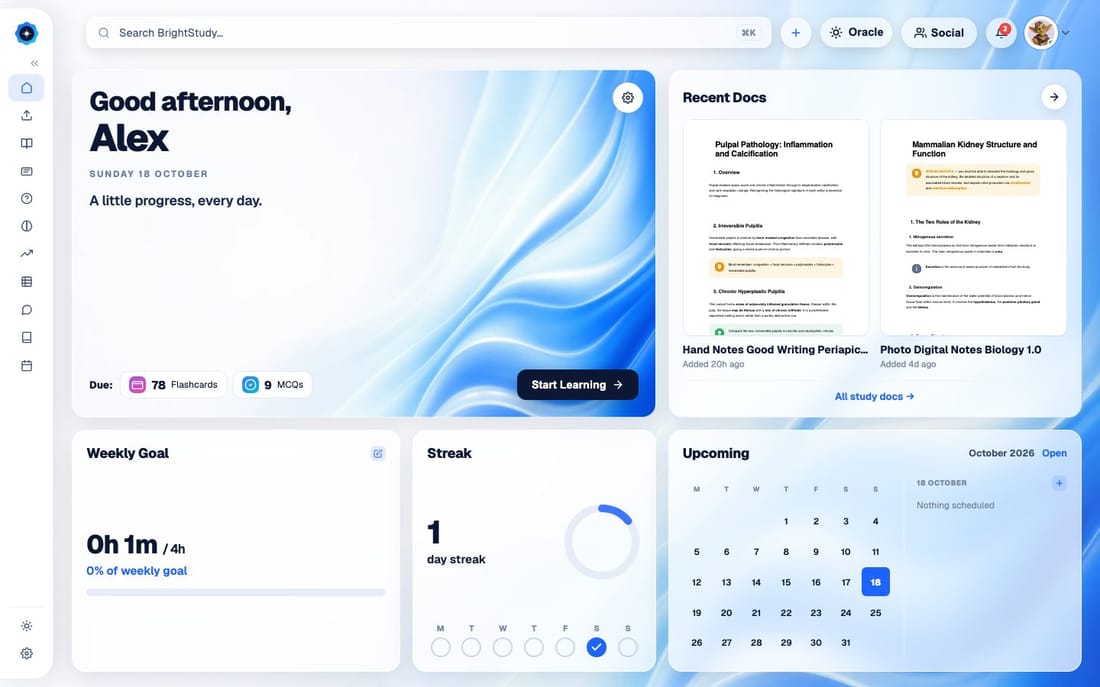
On paid plans, topic strength from your real flashcard and question results, accuracy trends, streaks and a weekly goal.
Vault
Two years of files organised in folders by subject, with diagrams extracted into an image library you can reuse in your notes.
Calendar
Plot mocks, NEA deadlines, UCAS milestones and exam dates in one view.
Oracle, the AI tutor
On paid plans, ask Oracle to explain a concept, walk through a problem or quiz you on a document.
Community Library
Reviewed Study Docs, flashcards and MCQs from BrightStudy and other students, approved by an admin before publishing.
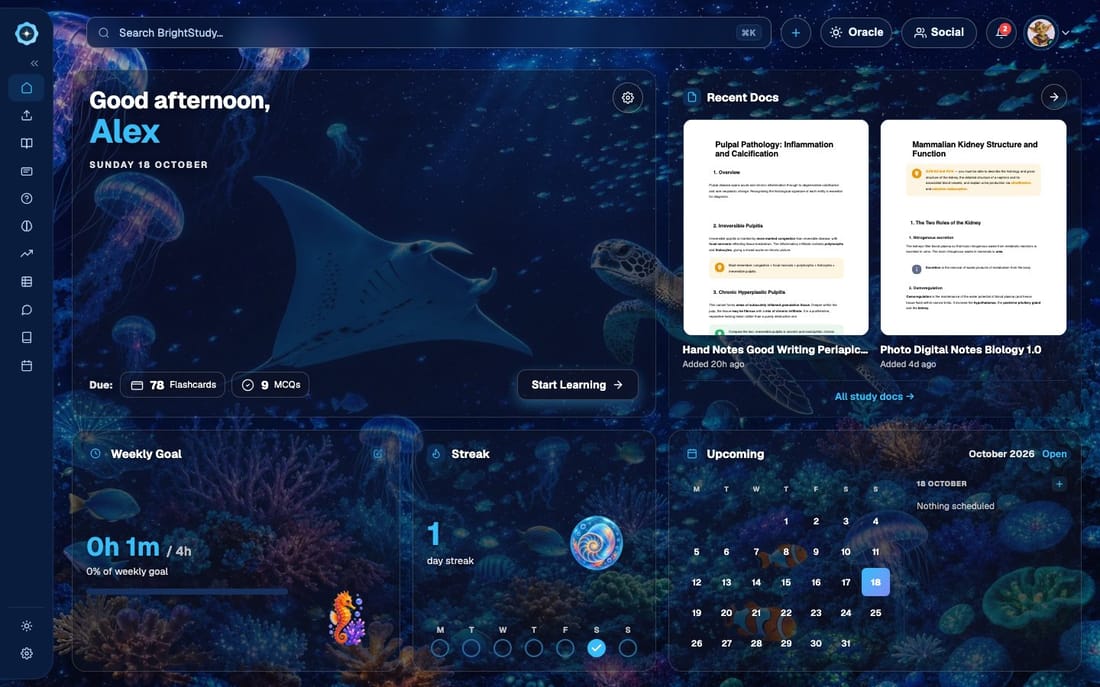
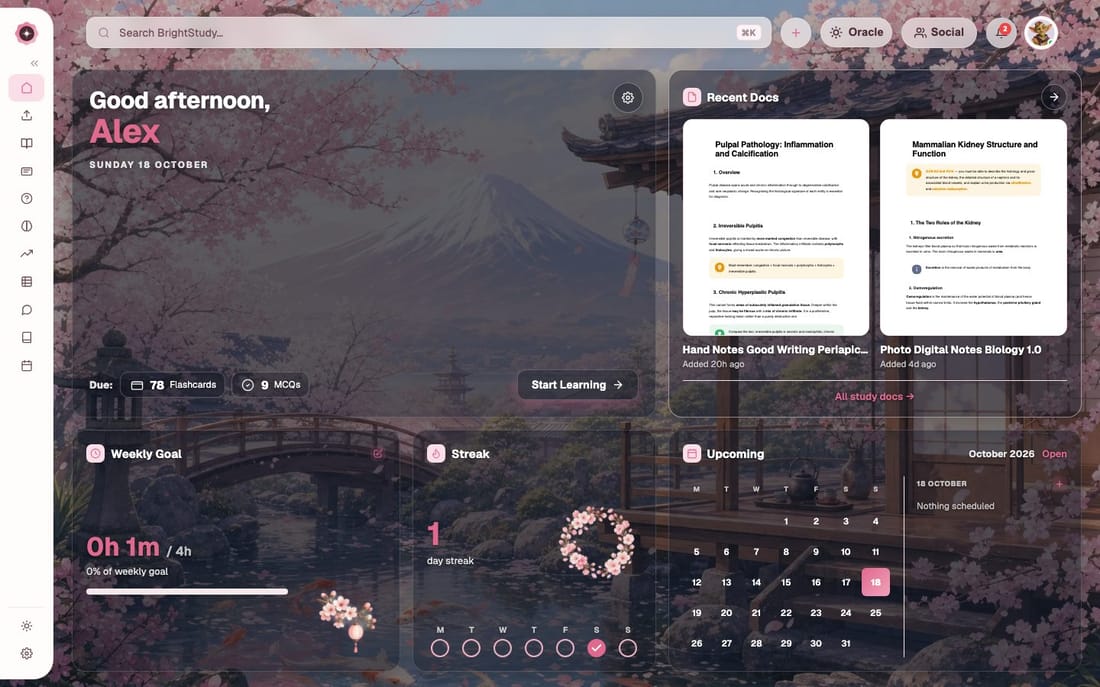
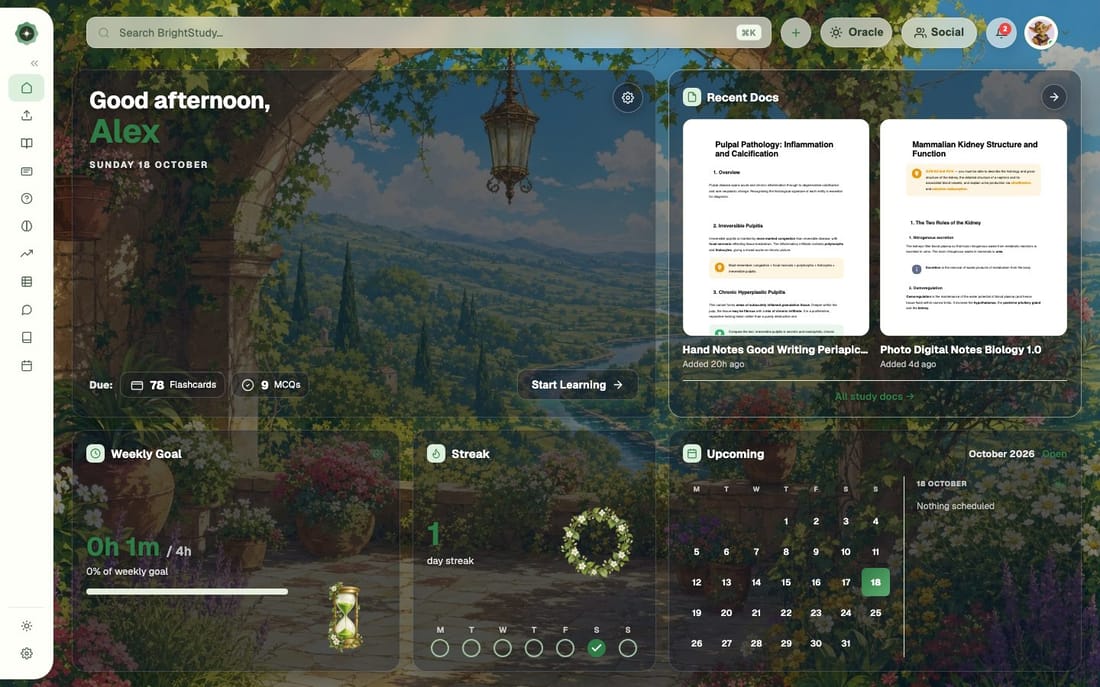
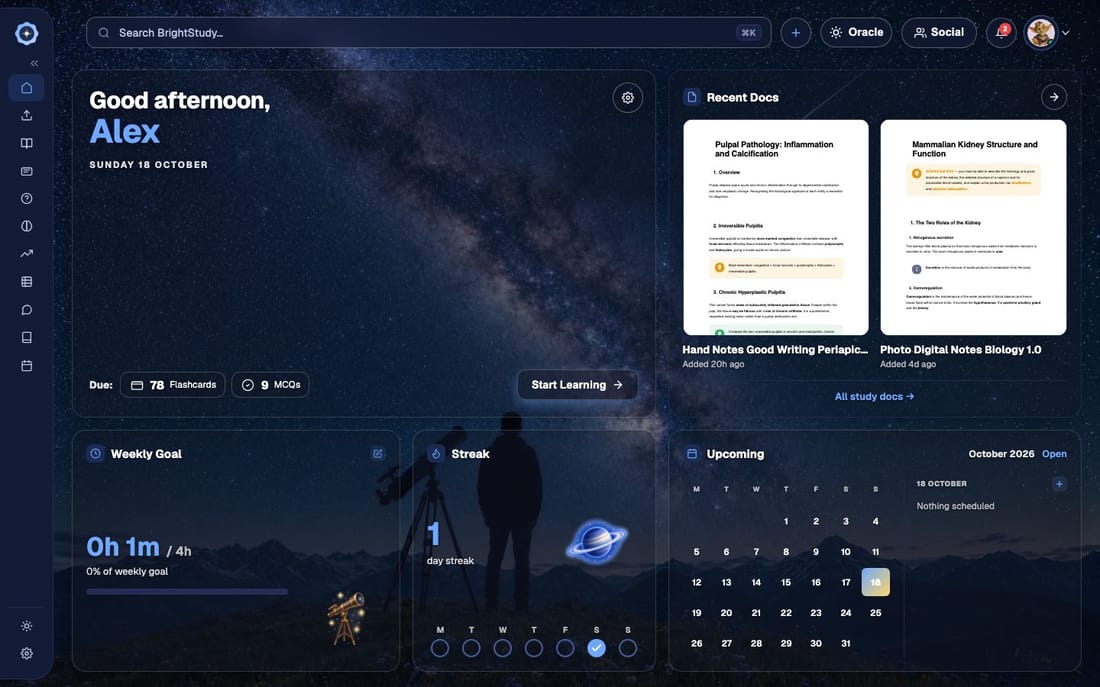
A study space for every mood
Pick from twelve themes, light and dark, and the whole of BrightStudy follows.
Common A level revision mistakes
Waiting until Year 13
Year 12 content is examined too. Without regular review it fades, and relearning it in Year 13 costs months.
Knowing content but not the mark scheme
Top grades depend on showing the skills the assessment objectives describe. Practise answers, not just facts.
Copying notes out again
Rewriting notes is slow and passive. Condense them once, then test yourself on them repeatedly.
Leaving NEA to the last minute
Coursework deadlines often fall just as exam revision should be starting. Finish NEA early.
Avoiding timed practice
Many A level papers are long and tightly timed. Practise working at exam pace well before the summer.
Burning out
Consistency over two years beats intensity in the final weeks. Keep rest in your timetable.
After A levels: university, apprenticeships and work
Most A level students apply to university through UCAS in the autumn of Year 13, with predicted grades from their teachers. Offers are usually conditional on your final results, which arrive in mid-August. Others choose degree apprenticeships, which combine a paid job with study towards a degree, or move straight into work.
Whichever you choose, the study habits you build at A level carry straight over. Read our guide to university study and degree revision to see what changes next.
A level revision: frequently asked questions
When should I start revising for A levels?
From the start of Year 12. Reviewing each topic as you learn it, with flashcards and practice questions, makes Year 13 revision about consolidation rather than relearning. Focused exam revision usually ramps up after Year 13 mocks.
How do I get an A* at A level?
Know the specification thoroughly, practise applying your knowledge to unfamiliar questions, learn exactly what the mark schemes reward, and test yourself regularly over the whole two years. Wider reading adds the depth of evaluation top answers need.
How many hours should I revise for A levels?
Many students do one to three hours of independent study on school days, rising in the final months. What matters most is that the time is active: questions, flashcards and timed practice rather than rereading.
Do AS levels count towards A levels?
In England, no. The AS is a separate qualification and its result does not count towards the A level. In Wales, AS results do count towards the full WJEC A level.
How many UCAS points is an A*?
An A* at A level is worth 56 UCAS tariff points, an A is 48 and a B is 40. An A* in the EPQ is worth 28.
What is the practical endorsement?
In biology, chemistry and physics, teachers assess your practical skills across the course and report a separate Pass or Not Classified alongside your grade. Some university science courses require a Pass.
Is the EPQ worth doing?
It is worth up to 28 UCAS points, some universities reduce offers for it, and it builds research skills you will use at university. It does take significant time, so plan it alongside your three A levels.
How do I revise for essay-based A levels?
Combine flashcards for knowledge (evidence, studies, quotations) with regular timed essay plans and full essays marked against the mark scheme. Deep Recall in BrightStudy is useful for practising explanations in your own words.
Can BrightStudy create flashcards from my A level notes?
Yes. Upload notes, slides, PDFs, Word documents, handwritten pages or YouTube lectures and BrightStudy can generate a Study Doc, flashcards and exam-style questions. AI generation uses an allowance on the free plan and is fully available on paid plans.
What are the hardest A levels?
Difficulty depends on your strengths, but further maths, the sciences, maths and modern languages are often described as the most demanding because of their content volume and the skills they require. Choose subjects you are good at and enjoy.
Can I take four A levels?
Some students do, often including further maths. Most university offers are based on three, so a fourth only helps if you can keep high grades in all of them.
When are A level results published?
A level results are released in mid-August, usually on a Thursday, and university places are confirmed through UCAS on the same day.
What if I miss my university offer?
You may still be accepted, especially if you are close. If not, UCAS Clearing matches applicants with available places, and you can also consider resits, a gap year or a degree apprenticeship.
Is BrightStudy free?
Yes, you can join for free and make unlimited flashcards, MCQs and Study Docs by hand and try the AI tools within an allowance. Spaced repetition, progress analytics, AI creation and the Oracle tutor are on paid plans; see pricing.
Other stages of UK study
Make your A level revision continuous, not last-minute
Upload a topic you studied this week and turn it into flashcards you will review until the final exam.