BTEC, T Level and apprenticeship study guide
How vocational qualifications work, how BTECs, T Levels, NVQs and apprenticeships are assessed and graded, every subject area, and practical study methods for each kind of assessment.
What further education is
Further education (FE) covers learning after GCSEs that is not a university degree. In England, everyone must stay in education or training until 18, and FE colleges, sixth form colleges, training providers and employers offer a wide range of routes: technical qualifications such as T Levels, vocational qualifications such as BTEC Nationals and City & Guilds or NCFE CACHE diplomas, apprenticeships, NVQs, Functional Skills in English and maths, and the Access to Higher Education Diploma for adults returning to study.
Vocational and technical courses are built around real occupations: health and social care, engineering, construction, digital, business, early years, creative media, sport and many more. They mix the knowledge you need for the job with practical skills, and many lead directly to work, an apprenticeship or university.
Qualifications are organised by level. Level 2 is broadly equivalent to GCSEs at grades 9 to 4, and Level 3 is equivalent to A levels. Most 16 to 18-year-old college students study at Level 2 or Level 3.

Vocational qualifications compared
The main further education routes differ in how they are delivered and assessed. This overview covers the qualifications most students meet.
| Qualification | Typical length | How it is assessed | Grades |
|---|---|---|---|
| T Level | 2 years full-time | Core exams, an employer-set project, occupational specialism assessments and an industry placement of at least 45 days | Pass, Merit, Distinction, Distinction* |
| BTEC National (Level 3) | 1–2 years | Internally assessed assignments plus externally set and marked units | Pass, Merit, Distinction, Distinction* |
| City & Guilds / NCFE CACHE diplomas | Varies | Assignments, practical observations, portfolios and tests | Pass, Merit, Distinction (varies) |
| Apprenticeship | 1–4 years | Learning on the job and off it, then an end-point assessment | Pass, Merit, Distinction (varies by standard) |
| NVQ | Varies | Evidence of competence collected at work, assessed by an assessor | Competent / not yet competent |
| Functional Skills | Weeks to months | Exams in English (reading, writing, speaking) or maths | Pass / Fail |
| Access to HE Diploma | Usually 1 year | Coursework and assignments across 60 credits | Pass, Merit, Distinction per unit |
BTECs explained: sizes, units and grades
Pearson BTEC Nationals are Level 3 vocational qualifications that come in several sizes. The Extended Certificate is the same size as one A level, the Diploma is equivalent to two, and the Extended Diploma to three. Many students combine a smaller BTEC with A levels.
Each BTEC is made up of units. Some are internally assessed through assignments set and marked by your college against published criteria; others are externally assessed through exams or set tasks marked by Pearson. Every unit has learning aims and assessment criteria for Pass, Merit and Distinction, and your overall grade comes from your unit results.
BTECs carry UCAS tariff points, so they can lead to university as well as to work. Government reforms are changing which Level 3 vocational qualifications are funded in England, so check the current course list with your college.
T Levels explained
T Levels are two-year technical qualifications for 16 to 19-year-olds, introduced in England from 2020 and developed with employers. One T Level is the same size as three A levels, and each focuses on an occupational area such as digital production, health, engineering and manufacturing, education and early years, or construction.
Every T Level has three parts: a core covering the knowledge and skills for the whole industry, assessed by exams and an employer-set project; an occupational specialism, assessed through practical tasks; and an industry placement of at least 45 days with a real employer.
T Levels are graded overall at Pass, Merit, Distinction or Distinction*, carry UCAS points, and can lead to skilled work, an apprenticeship or higher education.
Apprenticeships and end-point assessment
An apprenticeship is a paid job with training. Apprenticeships run from Level 2 (intermediate) to Level 7 (master’s level), and each follows an apprenticeship standard published by Skills England. The standard lists the knowledge, skills and behaviours (KSBs) a competent person in the role needs.
Apprentices spend part of their working week on off-the-job training, studying the knowledge behind the role. At the end, they take an end-point assessment (EPA) run by an independent organisation. Depending on the standard, EPA can include a knowledge test, a practical observation, a professional discussion, a project and a portfolio of evidence.
Preparing for EPA is like revising for any exam: know every KSB in your standard, collect evidence as you go, and practise explaining your work clearly in a professional discussion.

Functional Skills English and maths
Functional Skills qualifications test practical English and maths for everyday life and work. They are available from Entry Level 1 to Level 2, and Level 2 is widely accepted in place of a GCSE grade 4 for many jobs, apprenticeships and courses.
Maths papers test number, measurement, geometry and statistics in realistic problems, with calculator and non-calculator sections. English assessments cover reading, writing, and speaking, listening and communicating. Practice papers in the format of your awarding body are the most effective way to prepare.
Further education and vocational subject areas
These are the further education and vocational areas on our UK curriculum map. Each was researched from the qualification specifications and standards that define it: Pearson BTEC and T Level specifications, City & Guilds, NCFE CACHE and Highfield handbooks, Skills England occupational standards and the Department for Education’s Functional Skills content.
Sciences 1 subject · Pearson Edexcel
Maths and statistics 1 subject · Department for Education, City & Guilds, Pearson Edexcel
English and languages 2 subjects · Department for Education, City & Guilds, Signature
Humanities and social sciences 1 subject · Pearson Edexcel, QAA
Business, law and economics 10 subjects · Pearson Edexcel, Department for Education, City & Guilds, Skills England, AAT, NCFE CACHE
Computing, engineering and technology 8 subjects · Pearson Edexcel, Department for Education, Skills England
Medicine, health and care 6 subjects · Pearson Edexcel, Skills England, Department for Education, NCFE CACHE, Health and Safety Executive, Highfield
Arts, media and performance 5 subjects · Pearson Edexcel, RSL Awards
More subjects 6 subjects · City & Guilds, NCFE CACHE, Pearson Edexcel, National Association of Funeral Director, Skills England, Security Industry Authority
How to study for vocational courses
Vocational courses combine coursework, practical assessment and exams. Each needs a slightly different approach.
Read the grading criteria before you start
Pass, Merit and Distinction criteria tell you exactly what each assignment must show. Highlight the command words, such as describe, explain, analyse and evaluate, and plan your work around them.
Treat external units like exams
Externally assessed BTEC units and T Level core exams test knowledge. Use flashcards and practice questions, spaced over weeks, just as you would for GCSEs or A levels.
Connect theory to practice
Assessors reward applying knowledge to real situations. Keep notes of examples from your placement, workshop or job for every topic.
Build your evidence as you go
For portfolios, NVQs and apprenticeships, collect photos, witness statements and reflective notes every week. Reconstructing evidence at the end is stressful and incomplete.
Map your KSBs
Apprentices should list every knowledge, skill and behaviour in their standard and note the evidence for each. Gaps show you what to work on before EPA.
Plan around deadlines
Assignment deadlines cluster. Put every deadline in one calendar and work backwards to plan drafts.
Practise professional discussions
Explaining your work out loud, clearly and with examples, is a skill. Rehearse with a colleague, tutor or friend.
Keep English and maths ticking over
If you are also working towards GCSE resits or Functional Skills, schedule short, regular practice rather than leaving it to the week before.
Command words in vocational assessments
Grading criteria use command words that tell you how deep your answer must go. Understanding them is often the difference between a Pass and a Distinction.
| Command word | What it asks you to do | Typical grade |
|---|---|---|
| Describe | Give a clear account of the main features or steps. | Pass |
| Explain | Give reasons, showing how or why something happens. | Pass or Merit |
| Analyse | Break something into its parts and examine how they relate. | Merit |
| Compare | Identify similarities and differences. | Merit |
| Evaluate | Weigh up strengths and weaknesses and reach a supported judgement. | Distinction |
| Justify | Give evidence and reasons to support a decision or recommendation. | Distinction |
How to choose the right vocational course
Start with the job or sector you are interested in, then work backwards. Look at what employers in that area ask for, whether an apprenticeship is available, and whether you might want to go to university later. Some routes, such as nursing or teaching, eventually need a degree; others, such as many trades, value an apprenticeship or Level 3 qualification and experience above all.
Visit college open days, talk to tutors and current students, and ask practical questions: how much of the course is in workshops or placements, how it is assessed, what previous students went on to do, and what grades you need in English and maths to start.
If you have not yet got grade 4 in GCSE English or maths, you will usually keep working towards it alongside your course, through GCSE resits or Functional Skills. Planning time for this from the start makes it much easier to pass.
Making the most of your placement
Set goals with your employer
Agree at the start what you want to learn and which skills or criteria you need evidence for, and review progress regularly.
Keep a reflective log
Write a few lines after each day: what you did, what you learned and what you would do differently. These notes become evidence and assignment material.
Ask questions
Placements are for learning. Experienced colleagues are usually happy to explain why things are done the way they are.
Link it to your course
Notice where theory from your units shows up at work, and where practice differs. That comparison is exactly what assessors want to see.
Behave professionally
Punctuality, reliability and communication are assessed formally in many standards and informally by every employer.
Build your network
Many students find jobs and apprenticeships through their placement employer. Leave a good impression and ask about opportunities.
How to write vocational assignments that score highly
Unpack the brief
Read the assignment brief alongside the grading criteria and list exactly what each criterion requires. Check the command word for every task.
Research with purpose
Use your course materials, reputable websites, industry guidance and your own placement experience. Keep a note of every source you use.
Plan the structure
Organise your work under headings that match the criteria, so the assessor can easily find the evidence for each one.
Go beyond description for higher grades
Pass criteria often ask you to describe; Merit and Distinction ask you to analyse, evaluate and justify. Explain why, compare options and reach supported conclusions.
Use real examples
Specific examples from your placement, workshop or case studies show you can apply knowledge, which is central to vocational assessment.
Review before you submit
Check each criterion against your work, proofread carefully and make sure all sources are acknowledged. Your work must always be your own.
Revising for external exams and EPA knowledge tests
Externally assessed BTEC units, T Level core exams and apprenticeship knowledge tests work much like any other exam. The specification or assessment plan tells you what can be tested, and past or sample papers show the question style.
Build flashcards for key terms, legislation, processes and calculations as you go through each unit, and review them on a spaced schedule. In the final weeks, switch to timed practice questions and use the results to target your weakest areas.
For apprenticeship EPA, also prepare for the professional discussion or interview: review your portfolio, practise explaining what you did and why, and be ready to link examples to specific knowledge, skills and behaviours in your standard.
Balancing college, work and placement
Many further education students also work part-time, and apprentices study around a full-time job. A simple weekly plan, with fixed slots for assignments, revision and rest, prevents deadlines from sneaking up. Keep every deadline, shift and placement day in one calendar so clashes are obvious early.
If you are struggling, talk to your tutor or employer sooner rather than later. Colleges and training providers can often adjust deadlines or provide extra support, but only if they know.
Skills employers look for alongside your qualification
Vocational qualifications show you have the technical knowledge for a role, but employers also look for the behaviours that make someone good to work with: reliability, communication, teamwork, problem-solving and a willingness to learn. Many apprenticeship standards list these explicitly as behaviours that are assessed.
Build evidence of them as you go. Keep notes of times you solved a problem, worked well in a team or took responsibility at work or on placement. They will help in assignments, end-point assessments, job applications and interviews.
Popular vocational sectors and what they involve
Health and social care
Care values, anatomy and physiology, safeguarding, communication and working in health and care settings, often with placements. Leads to care roles, nursing and allied health degrees.
Engineering and manufacturing
Engineering principles, maths, materials, design and workshop skills, with routes into maintenance, manufacturing, electrical and mechanical roles.
Construction and the built environment
Building technology, health and safety, surveying, design and trade skills such as carpentry, plumbing and electrical installation.
Digital and IT
Programming, networking, cyber security, data and digital support, leading to technical roles, apprenticeships and computing degrees.
Business and administration
Finance, marketing, customer service, management and administration, with routes into most industries.
Early years and education
Child development, play and learning, safeguarding and supporting children with additional needs, leading to early years and teaching assistant roles.
Higher technical qualifications, HNCs and HNDs
After a Level 3 qualification, you do not have to choose between a three-year degree and going straight into work. Higher Technical Qualifications (HTQs), Higher National Certificates (HNCs, Level 4) and Higher National Diplomas (HNDs, Level 5) offer one or two years of specialist technical study, often at a college, with strong links to employers. Many can be topped up to a full degree later.
Higher and degree apprenticeships take this further, combining a paid job with study up to Level 6 or Level 7, often with a university. They are available in sectors such as engineering, digital, business, healthcare and construction, and the employer and government cover the tuition costs.
These routes suit people who want a high-level qualification while staying close to industry. The study skills are the same as for any course at this level: active recall for knowledge, careful planning for assignments, and steady evidence-building for practical assessment.
Turn course materials into notes, flashcards and practice
Upload your unit specifications, course handouts, workbooks, slides, PDFs or photos of handwritten notes. BrightStudy turns each into a structured Study Doc you can edit, and can generate flashcards and exam-style questions from the same material for externally assessed units and EPA knowledge tests.
Everything lives in your Vault, organised by folders you choose, so assignment research, placement notes and revision materials are always in one place. The Calendar keeps deadlines, placement days and exam dates together.
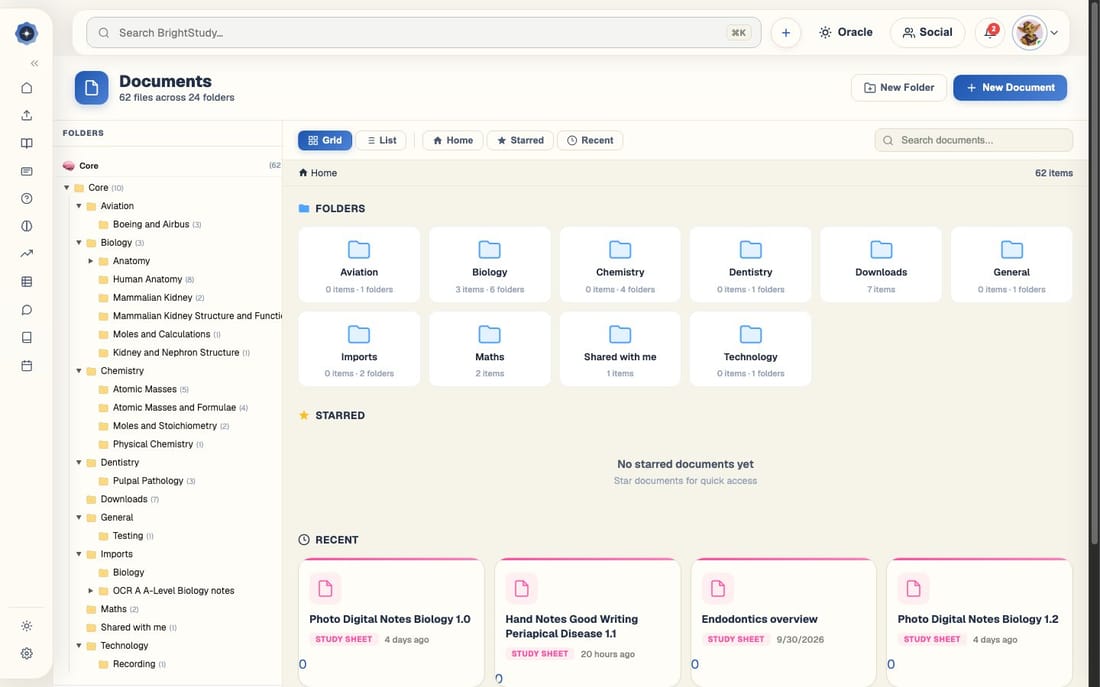
How BrightStudy supports vocational learners
Unlimited manual cards on the free plan
Write your own flashcards and multiple-choice questions for KSBs, regulations or key terms, as many as you like, free.
Spaced repetition
On paid plans, cards and questions are scheduled to come back just before you would forget them, with a daily Due queue.
Exam-style questions
Questions written to match your study profile, each with an explanation of why the right answer is right and why the others are wrong.
Oracle, the AI tutor
On paid plans, ask Oracle to explain a regulation, a process or a concept from your course again in plain language.
Progress tracking
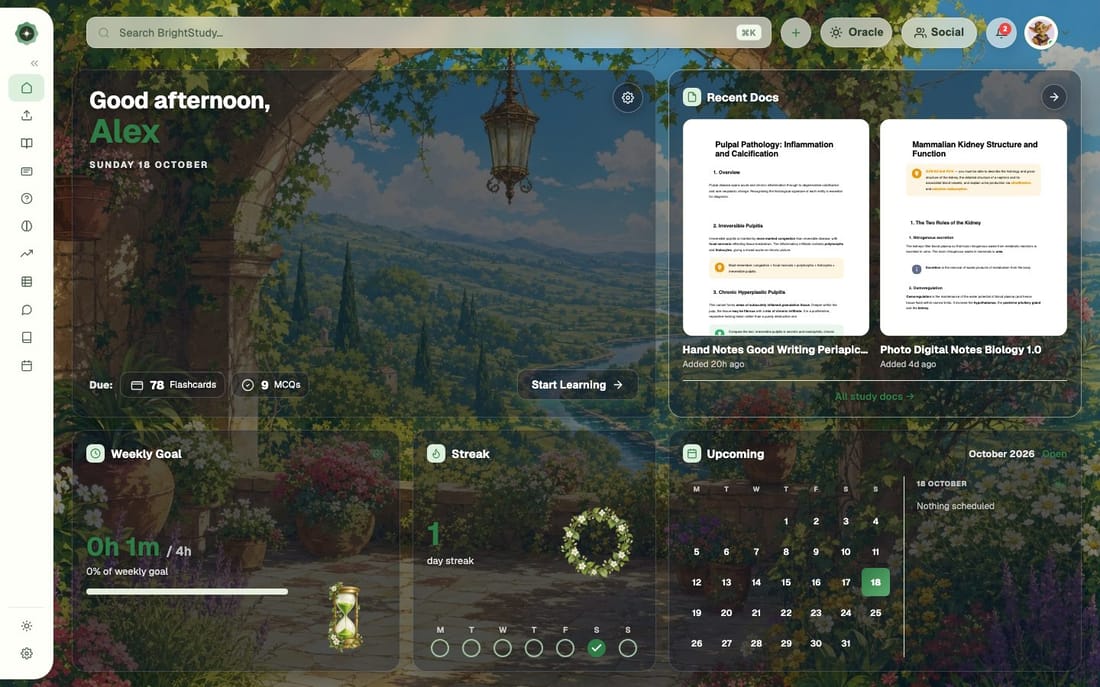
On paid plans, see which topics are strong and which need work, with streaks and a weekly goal.
Works on any device
Study in the browser on a phone, tablet or laptop, in a break at work or on the bus. Mobile apps are coming soon.
Your study space, your way
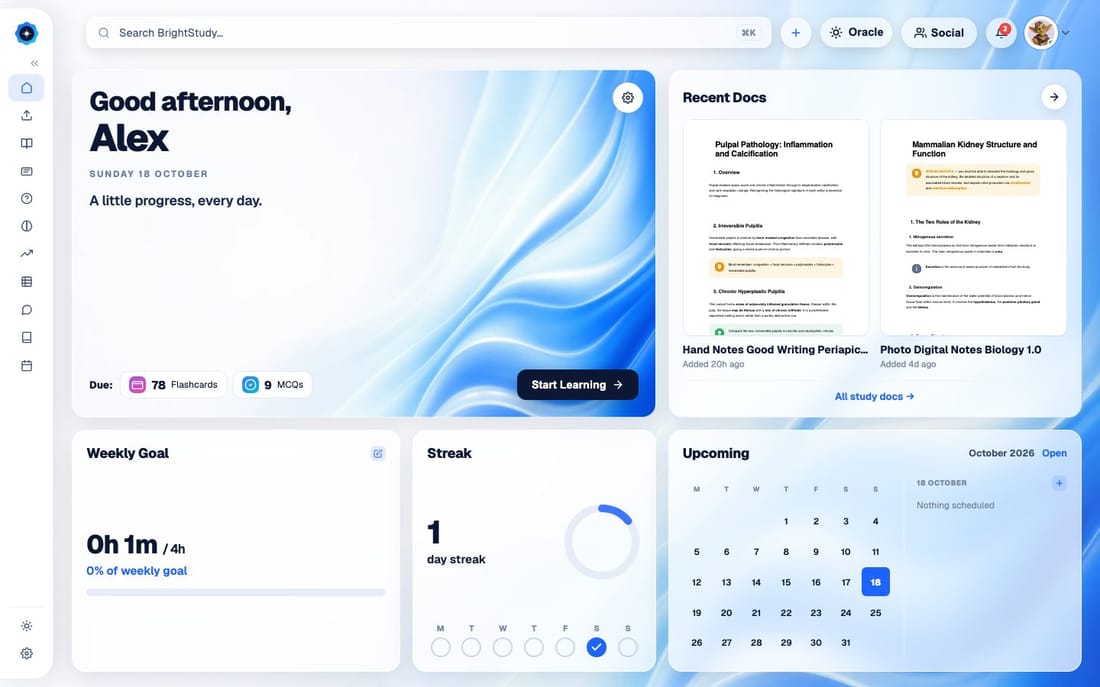
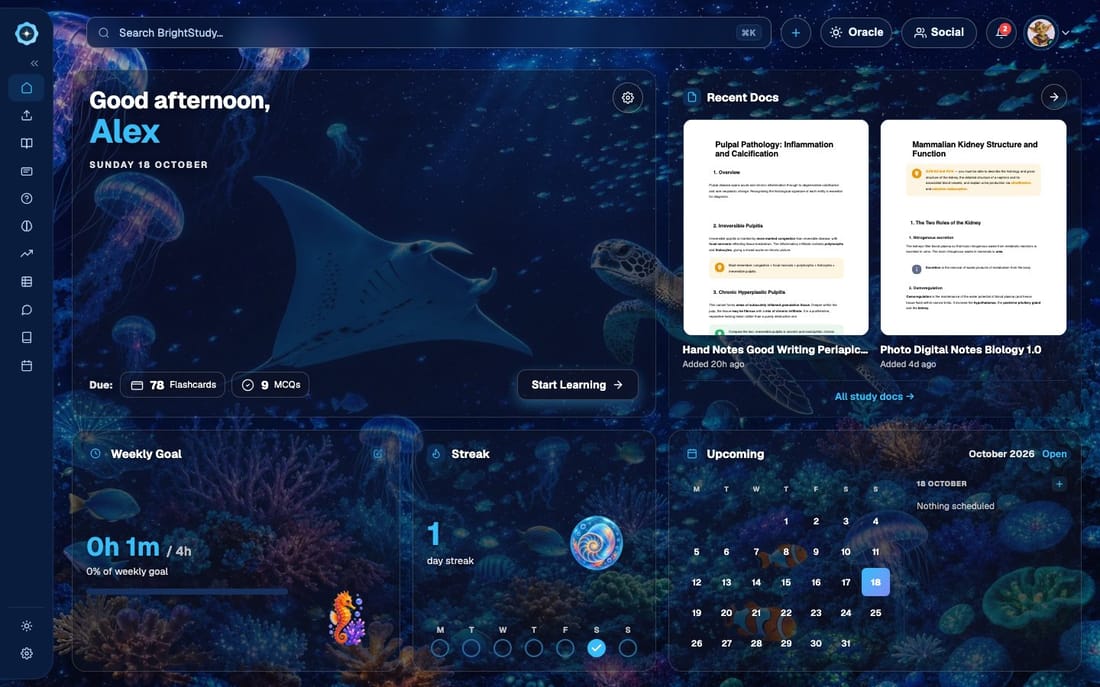
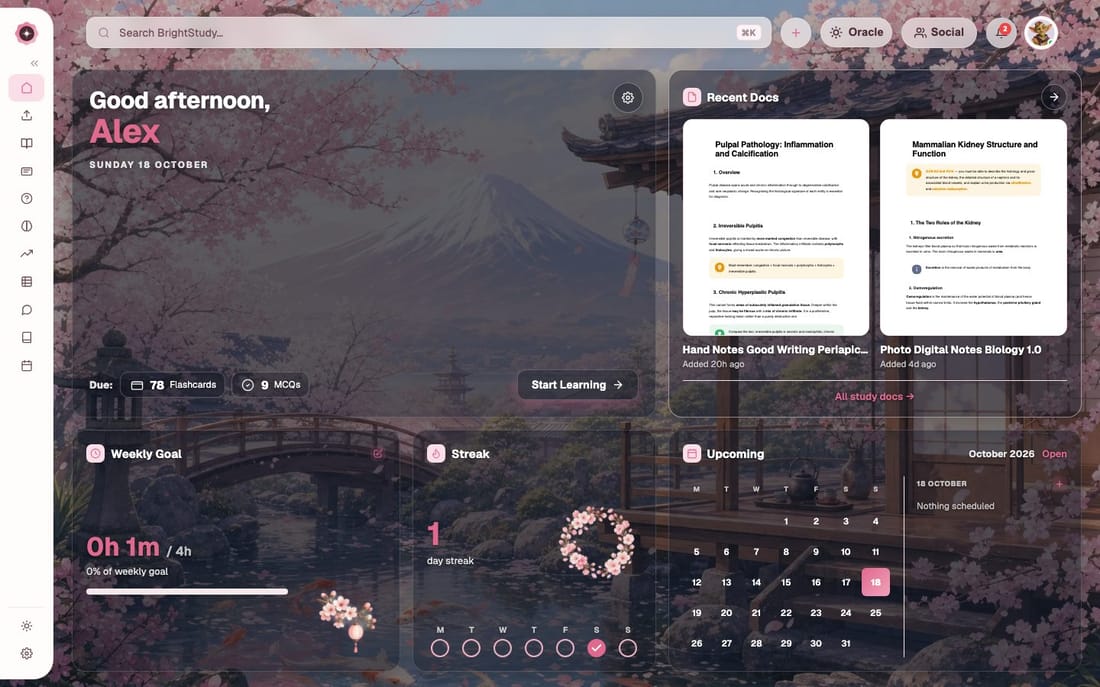
Choose from twelve themes, light and dark. The whole of BrightStudy follows your choice.

Where vocational qualifications can lead
A Level 3 vocational qualification or T Level can lead directly into skilled employment, a higher or degree apprenticeship, a Higher National Certificate or Diploma (HNC or HND), or a university degree. Many universities accept BTECs and T Levels, sometimes alongside A levels, and publish their requirements on each course page.
Adults returning to education can take an Access to HE Diploma to prepare for university. Read our guides to university study and adult learning for the next steps.
BTEC, T Level and apprenticeship FAQs
What is the difference between a BTEC and a T Level?
BTECs are vocational qualifications made up of units assessed through a mix of assignments and external exams, available in several sizes. T Levels are two-year technical courses equivalent to three A levels, developed with employers and including an industry placement of at least 45 days.
Is a BTEC equivalent to A levels?
At Level 3, yes in size: a BTEC Extended Certificate is the size of one A level, a Diploma two and an Extended Diploma three. All carry UCAS tariff points.
How are BTECs graded?
Each unit is graded Pass, Merit or Distinction, and unit results combine into an overall grade that can reach Distinction*, such as DMM or D*D*D* for the larger qualifications.
What is end-point assessment?
The final assessment of an apprenticeship, carried out by an independent organisation. It checks that you can do the job to the standard, through methods such as a knowledge test, observation, professional discussion and portfolio.
What are KSBs?
Knowledge, skills and behaviours: the list in each apprenticeship standard of what a competent person in the role needs. Your training and your EPA are built around them.
Is Functional Skills Level 2 the same as a GCSE?
Functional Skills Level 2 in English or maths is widely accepted instead of a GCSE grade 4 for jobs, apprenticeships and many courses, though some universities and employers specifically ask for GCSEs.
Can I go to university with a BTEC or T Level?
Yes. Many universities accept BTECs and T Levels for a wide range of courses. Requirements vary by course, so check each university’s entry requirements.
How do I get a Distinction in my BTEC?
Read the Distinction criteria for every assignment before you start, plan your work to meet them, go beyond description to evaluation and justification, and revise properly for the externally assessed units.
How many UCAS points is a BTEC Extended Diploma?
A BTEC National Extended Diploma is the same size as three A levels, so its UCAS points are comparable: D*D*D* is worth 168 points, the same as A*A*A* at A level.
How long is an apprenticeship?
At least 12 months, and often two to four years depending on the level and the occupation. Higher and degree apprenticeships usually take longer.
Do apprentices get paid?
Yes. Apprentices are employees and must be paid at least the apprentice minimum wage, rising to the National Minimum Wage for their age after the first year if they are 19 or over.
What is an NVQ?
A National Vocational Qualification is competence-based: you show you can do a job to the required standard, usually by building a portfolio of evidence at work that an assessor checks.
Can adults do T Levels?
T Levels are designed for 16 to 19-year-olds. Adults usually take apprenticeships, Level 3 vocational qualifications or an Access to HE Diploma instead.
Can BrightStudy help me revise for my external units?
Yes. Upload your course materials and BrightStudy can create Study Docs, flashcards and exam-style questions from them, or you can write unlimited cards by hand on the free plan.
Is BrightStudy free?
You can join for free. Paid plans add spaced repetition scheduling, progress analytics, AI creation and the Oracle tutor; see pricing.
What is the difference between Level 2 and Level 3?
Level 2 is broadly equivalent to GCSEs at grades 9 to 4, and Level 3 to A levels. Level 3 qualifications such as BTEC Nationals and T Levels can lead to university or higher apprenticeships.
What is an HNC or HND?
Higher National Certificates (Level 4) and Higher National Diplomas (Level 5) are technical higher education qualifications, usually one or two years long, that can often be topped up to a full degree.
Can I do an apprenticeship at any age?
Yes. There is no upper age limit for apprenticeships in England, and many adults use them to retrain or progress in their current job.
How do I prepare for a professional discussion in my EPA?
Review your portfolio, practise explaining what you did and why with specific examples, and link each example to the knowledge, skills and behaviours in your apprenticeship standard.
Other stages of UK study
Bring your coursework, placement notes and revision together
Upload your unit materials and build flashcards for the parts that are examined.