Sketchnoting Starter Pack
Visual note-taking for people who cannot draw: a small visual vocabulary, four page layouts and practice pages to build the habit.
About this resource
Sketchnotes combine words, simple shapes and structure so that a page of notes is memorable at a glance. You do not need to draw well; you need about twenty shapes (containers, arrows, people, icons) and a layout. This pack teaches that vocabulary on one page, shows four layouts (linear, radial, path and grid) with when to use each, works through a sketchnoted topic step by step, and gives you practice pages for copying the vocabulary and for your first three topics.
What is included
- A twenty-shape visual vocabulary with how to draw each in three strokes
- Four page layouts and which subjects suit each
- Step-by-step example: a History topic turned into a sketchnote
- Lettering and hierarchy rules for titles, headings and body text
- Vocabulary practice page and three blank layout pages
Who it is for
Students who remember what they see better than what they read, and anyone whose written notes feel like a wall of text.
Inside the PDF
- The visual vocabulary
- Layouts, hierarchy and an example
- Vocabulary practice
- Linear layout page
- Radial layout page
- Path layout page
Related resources
 Template
Cornell Notes Template
The classic three-part note page (cues, notes, summary) with a one-page guide to using it so every page becomes a self-test.
PDF14 pages281 KB
 Worksheet
Lecture Capture Sheet
A before, during and after sheet for lectures and lessons: pre-read questions, live notes with a questions margin, and a ten-minute consolidation.
PDF12 pages286 KB
 Template
Textbook and Reading Notes Template
An SQ3R-based template for reading chapters and papers so you finish with questions answered and a summary, not just highlighted pages.
PDF15 pages293 KB
Questions, answered
How to get the most from this resource.
Try BrightStudy free and upload your first document, or email us at support@brightstudy.ai.
I really cannot draw. Will this work?
Is it slower than normal notes?
Which layout should I start with?
Can I do this digitally?
Pair it with BrightStudy
Move across the strips · tap one to explore
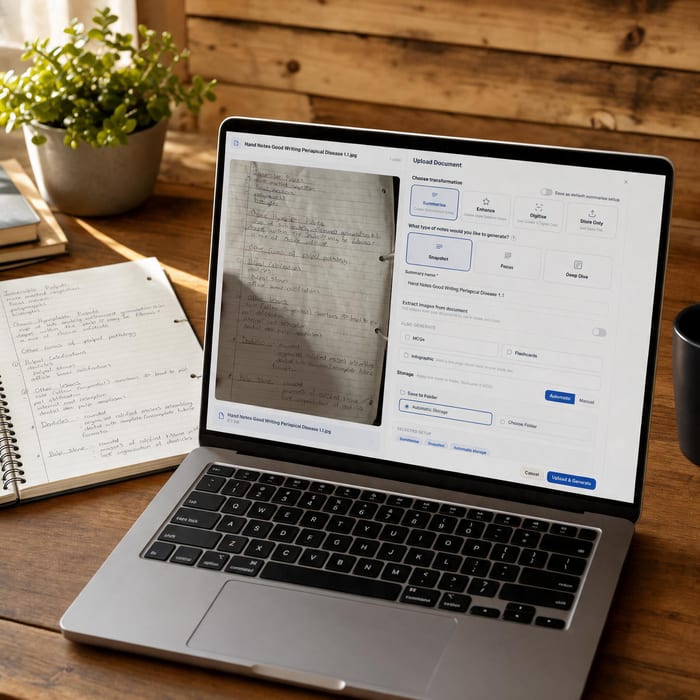

Plan on paper. Revise with BrightStudy.
Upload your notes and get Study Docs, flashcards and MCQs in minutes, then let spaced repetition decide what to review each day.
- Free plan to get started
- Study Docs, flashcards and MCQs
- Runs in your browser